This Monaco tax guide covers the rules in force from 1 January 2026. Residents pay 0% personal income tax — a rule dating from 1869 — plus nothing on capital gains, dividends, interest, wealth or annual property holding. The main levies are the 25% business profits tax (ISB) on internationally-trading companies, French-aligned VAT at 20%, and inheritance duty on Monaco-situs assets only (0% in the direct line). The catch is entry cost: a ~€500,000 (~$570,000) bank deposit, scarce housing, and — for French nationals — the 1963 treaty that keeps them taxable in France.
Introduction
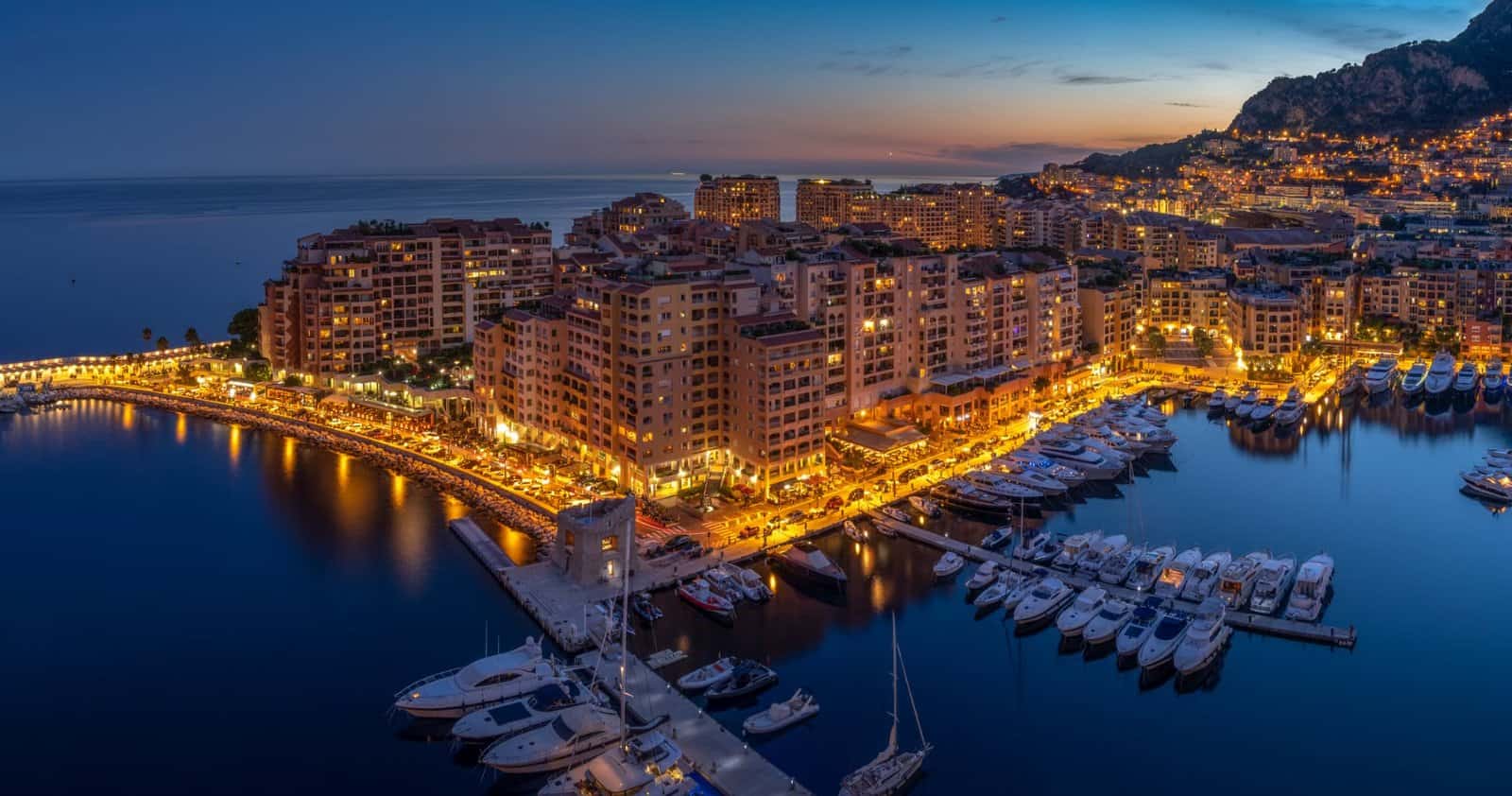
Monaco is a two-square-kilometre city-state on the French Riviera, a constitutional monarchy under Prince Albert II, bordered by France on three sides and the Mediterranean on the fourth. It is not an EU member, but it uses the euro by agreement, sits inside the EU customs territory through France, and applies French-style VAT under a shared framework. French is the official language (English and Italian are everywhere), the legal system is French-inspired civil law, the climate delivers 300 days of sun, and daily life is famously safe — one police officer per hundred residents. Cost of living is the highest in Europe: prime apartments trade above €50,000 (~$57,000) per square metre.
For internationally-mobile investors, this Monaco tax guide matters because the Principality is the purest zero-income-tax jurisdiction in Europe — no personal income tax since 1869, no capital gains tax, no wealth tax, and no annual property tax, all inside a politically stable, euro-denominated enclave 30 minutes from Nice airport. The regime is old and stable rather than new and reformable; the recent action is on the compliance side, where Monaco has been on the FATF grey list since June 2024 and, after the June 2026 plenary confirmed its action plan substantially complete, is working toward an exit expected after the pending on-site inspection.
Direct Taxes
Monaco levies no personal income tax on residents — regardless of where their income arises — with one nationality-based exception: French citizens who moved to Monaco after 1957 remain taxable in France on worldwide income under the 1963 Franco-Monegasque Convention. There is no general corporate income tax either; instead, the business profits tax (Impôt sur les Bénéfices, ISB) applies only to enterprises that earn more than 25% of turnover outside Monaco or derive income from intellectual property. The ISB is the key concept for investors: purely local businesses pay nothing on profits, while internationally-trading ones pay French-level rates.
Personal income tax (2026 bands)
| Chargeable income (EUR) | Rate |
|---|---|
| All income, any amount | 0% |
| French nationals (post-1957 arrivals, 1963 Convention) | Taxed by France at French rates |
The 0% rate has applied since Prince Charles III abolished income tax in 1869, funded then by casino revenue and today by VAT, registration duties and state monopolies. There are no bands, no filings for individuals, and no municipal income taxes. The only carve-out is the French-national rule — and Monaco issues tax-residence certificates, but other countries’ tie-breaker tests still apply to people splitting time across borders.
Corporate income tax (business profits tax, ISB)
| Item | Rate |
|---|---|
| ISB — companies with >25% of turnover outside Monaco, or IP income (from 2022) | 25% |
| ISB — prior rates (2019–2021, phased reduction) | 31% → 28% → 26.5% |
| Companies earning ≥75% of turnover inside Monaco | 0% (outside ISB scope) |
| New-business relief — years 1–2 / 3 / 4 / 5 | 0% / 6.25% / 12.5% / 18.75% (effective) |
| Withholding tax on dividends, interest, royalties paid abroad | 0% |
The 25% rate has applied since 2022, completing a phased cut from 33.33%. The base is territorial-plus: only internationally-oriented profits are caught. Dividends received can benefit from a participation-style relief, losses carry forward, and there is no withholding tax on outbound payments. Monaco has no Pillar Two domestic top-up tax as of 2026 (large multinational groups should assess top-up exposure in other jurisdictions where they operate — confirm current status before structuring).
Social security and health contributions
| Contribution | Employee | Employer | Self-employed |
|---|---|---|---|
| Health, family, pension & unemployment (all funds, approximate combined) | ~13–15% | ~30–35% | Fixed CAMTI/CARTI quotas by income bracket |
Monaco’s system (Caisses Sociales de Monaco) mirrors the French model: CCSS for health and family benefits (employer-funded), CAR for basic pensions (shared, capped at €4,760/month, ~$5,400, of gross salary in 2026), plus CMRC supplementary pension and unemployment insurance at a 6.45% global rate. Exact percentages vary by fund and sector — confirm current rates with the Caisses Sociales for payroll planning. The minimum wage (SMIC) is €12.02 (~$13.70) gross per hour from 1 January 2026. High employer costs are the flip side of the zero-income-tax deal for staff.
Indirect Taxes
Monaco applies VAT under a customs and fiscal union with France — same rates, same rules, collected by Monaco for its own budget. VAT is the state’s single largest revenue source, which is precisely why the income-tax-free model is sustainable.
Value-added tax (VAT)
| Rate | Applies to (examples) |
|---|---|
| 20% (standard) | Most goods and services, including property transactions where applicable |
| 10% (reduced) | Restaurants, transport, renovation works |
| 5.5% (reduced) | Food, books, energy |
| 2.1% (super-reduced) | Press, certain medicines |
| 0% (zero) | Exports and international transport |
Excise and other indirect taxes
| Tax | Notes |
|---|---|
| Excise duties | Alcohol and tobacco, French-aligned |
| Registration duty — property purchase | 4.75% for individuals and transparent Monegasque civil companies (raised from 4.5% — confirm current rate); 7.5% via opaque/foreign structures |
| Lease registration | 1% of annual rent on residential leases |
| Stamp duties | On deeds and official documents |
Other Taxes Worth Knowing
| Tax | Monaco treatment |
|---|---|
| Capital gains tax (individuals) | None |
| Dividends (resident individual) | 0% — no tax on receipt, no withholding |
| Interest (resident individual) | 0% |
| Rental income (individual landlord) | No income tax; only the 1% lease registration duty |
| Wealth / net worth tax | None |
| Inheritance tax — spouse & direct line (children, parents) | 0%, Monaco-situs assets only |
| Inheritance tax — siblings / uncles & nephews / other relatives / unrelated | 8% / 10% / 13% / 16%, Monaco-situs assets only |
| Gift tax | Same rates and kinship scale as inheritance tax |
| Immovable property tax (annual) | None |
| Exit tax | None |
The inheritance and gift base is strictly territorial: only assets physically or legally situated in Monaco (local real estate, Monegasque bank accounts and portfolios) are in scope, whatever the residence or nationality of the deceased. A foreign portfolio held with a non-Monaco custodian passes outside Monegasque death duties entirely — and in the direct line even Monaco assets pass at 0%. For a typical resident investor the entire recurring tax bill is VAT on consumption plus the 1% on their lease.
Disadvantages & Risks
The entry ticket is the biggest constraint. Housing is the world’s most expensive and the state links residence permits to genuine accommodation — the bank-reference route in practice means depositing around €500,000 (~$570,000) with a Monegasque bank, and banks’ compliance screening has tightened markedly since Monaco joined the FATF grey list in June 2024. As of the June 2026 plenary the action plan is judged substantially complete and an on-site visit is pending, but until formal removal, residents can expect enhanced due-diligence friction from counterparty banks abroad. Monaco is not on the EU tax blacklist and exchanges account information under CRS (an updated protocol with the EU applies from 2026), so this is a compliance-reputation issue, not secrecy.
Structural risks follow from being a city-state of ~39,000 residents: total dependence on France for utilities, labour and market access; a treaty-thin network — Monaco’s agreements are mostly information-exchange, not double-tax treaties, so foreign withholding taxes on dividends and royalties are generally unrelievable; and the permanent French-national exception, which France polices vigorously (it also applies a special 3-year rule to French property wealth). For everyone else the regime’s stability is exceptional — the 0% rule has survived 157 years — but anyone whose income sources sit in high-withholding countries will find that zero tax at home does not fix taxation at source.
Strategy & Ideal Profile
The classic structure is simple: become a genuine Monaco resident, hold liquid wealth personally or through a Monegasque civil company (SCP), and keep operating businesses offshore in treaty-rich jurisdictions since Monaco itself offers no treaty relief. Passive income — dividends, interest, gains — arrives tax-free with no reporting burden. Business owners who want to run operations from Monaco should model the ISB carefully: if more than 25% of turnover is earned outside the Principality, profits face 25% (softened for the first five years by the new-business ramp), while a genuinely local service business pays nothing. Buying the home through a transparent structure keeps registration duty at 4.75% rather than 7.5%, and direct-line succession planning is trivially clean at 0%.
Who it suits: investors and traders with substantial liquid portfolios — zero tax on gains, dividends and interest with no sunset; retirees and rentiers whose income is passive; dividend earners who can take distributions from foreign companies withholding-free at Monaco’s end; athletes, executives and founders post-exit who can realise gains as residents; and families planning succession, since direct-line transfers of even Monaco assets bear no duty. Residency itself is administrative rather than tax-based: proof of accommodation, the bank deposit, clean record, then a carte de séjour — but spending 183+ days (or making Monaco the centre of your life) is what makes foreign tax authorities accept the move.
Who it does not suit: French nationals, taxed by France regardless under the 1963 Convention; owners of businesses that must trade internationally from Monaco, who face 25% ISB plus ~30–35% employer social costs; anyone needing double-tax-treaty relief on source-country withholding; and anyone for whom a seven-figure housing commitment is disproportionate — the tax saving must clear the Monaco cost-of-living hurdle first. The 0% headline has no sunset clause, but the compliance bar keeps rising; budget for slow, document-heavy banking.
FAQ
Is Monaco a tax haven?
Monaco is a zero-personal-income-tax jurisdiction, but not a secrecy haven: it exchanges financial account information automatically under CRS, is not on the EU tax blacklist, and was removed from the OECD’s uncooperative list in 2009. It is currently on the FATF grey list for AML effectiveness (exit process well advanced in 2026), which affects banking friction rather than tax treatment.
What is the corporate tax rate in Monaco in 2026?
There is no general corporate income tax. The business profits tax (ISB) at 25% applies only to enterprises earning more than 25% of turnover outside Monaco or receiving IP income. Purely local businesses pay 0%, and new companies within ISB scope pay nothing for two years, then 6.25%, 12.5% and 18.75% before reaching the full rate.
Why don’t French citizens benefit from Monaco’s 0% income tax?
Under the 1963 Franco-Monegasque Convention, French nationals who take up residence in Monaco remain taxable in France on worldwide income (except a small grandfathered pre-1957/1963 group). No other nationality is affected.
How do you become a Monaco resident?
Applicants over 16 need accommodation in Monaco (owned or rented), proof of financial self-sufficiency — in practice a reference from a Monegasque bank, typically requiring a deposit of about €500,000 (~$570,000) — and a clean criminal record, then an interview for the carte de séjour. Long-term residence upgrades through temporary, ordinary and privileged permit stages.
Does Monaco tax capital gains?
No. Individuals pay no tax on capital gains of any kind — securities, crypto, or real estate — whether Monaco or foreign situs. Only businesses within ISB scope include gains in taxable profits.
Is there inheritance or wealth tax in Monaco?
There is no wealth tax and no annual property tax. Inheritance and gift duty applies only to Monaco-situs assets: 0% for spouses and the direct line, 8% for siblings, 10% for uncles/aunts/nieces/nephews, 13% for other relatives and 16% for unrelated beneficiaries. Foreign-situs assets are outside the base entirely.
How are dividends taxed for a Monaco resident?
Monaco imposes no tax on dividends received and no withholding on dividends paid. The practical cost is foreign withholding at source — Monaco has almost no double-tax treaties, so, for example, US or French dividend withholding is generally a final cost.
Sources
All figures should be checked against the primary government sources below.
- Gouvernement Princier / Mon Service Public — tax system overview and registration duties — monservicepublic.gouv.mc
- Direction des Services Fiscaux (Monaco tax authority, via government portal) — ISB, VAT and duties — gouv.mc
- Caisses Sociales de Monaco — employer, employee and self-employed contribution rates and ceilings — caisses-sociales.mc
- FATF — Monaco listing status and mutual-evaluation documents — fatf-gafi.org
- European Central Bank — EUR/USD reference rate used for conversions — ecb.europa.eu
USD figures are indicative conversions at ~1 EUR = 1.14 USD (ECB reference rate, early July 2026) and rounded.
Last verified: 5 July 2026.
This is general information, not personal tax or legal advice. Tax outcomes depend on your specific facts; consult a qualified Monaco tax adviser before acting.
Related guides: Andorra · Argentina · Australia · Bahamas · Botswana · Brunei · Bulgaria · Ceuta and Melilla · Chile · China · Costa Rica · Cyprus · Denmark · Dominican Republic · El Salvador · Estonia · Florida · Georgia · Gibraltar · Greece · Hawaii · Hong Kong · Iceland · Indonesia · Isle of Man · Italy · Jersey · Kuwait · Latvia · Macau · Malta · Mauritius · Montenegro · Morocco · New Zealand · Panama · Paraguay · Philippines · Portugal · Puerto Rico · Romania · Sark · Seychelles · Singapore · South Korea · Taiwan · Thailand · Ticino · UAE · Uruguay · Zug