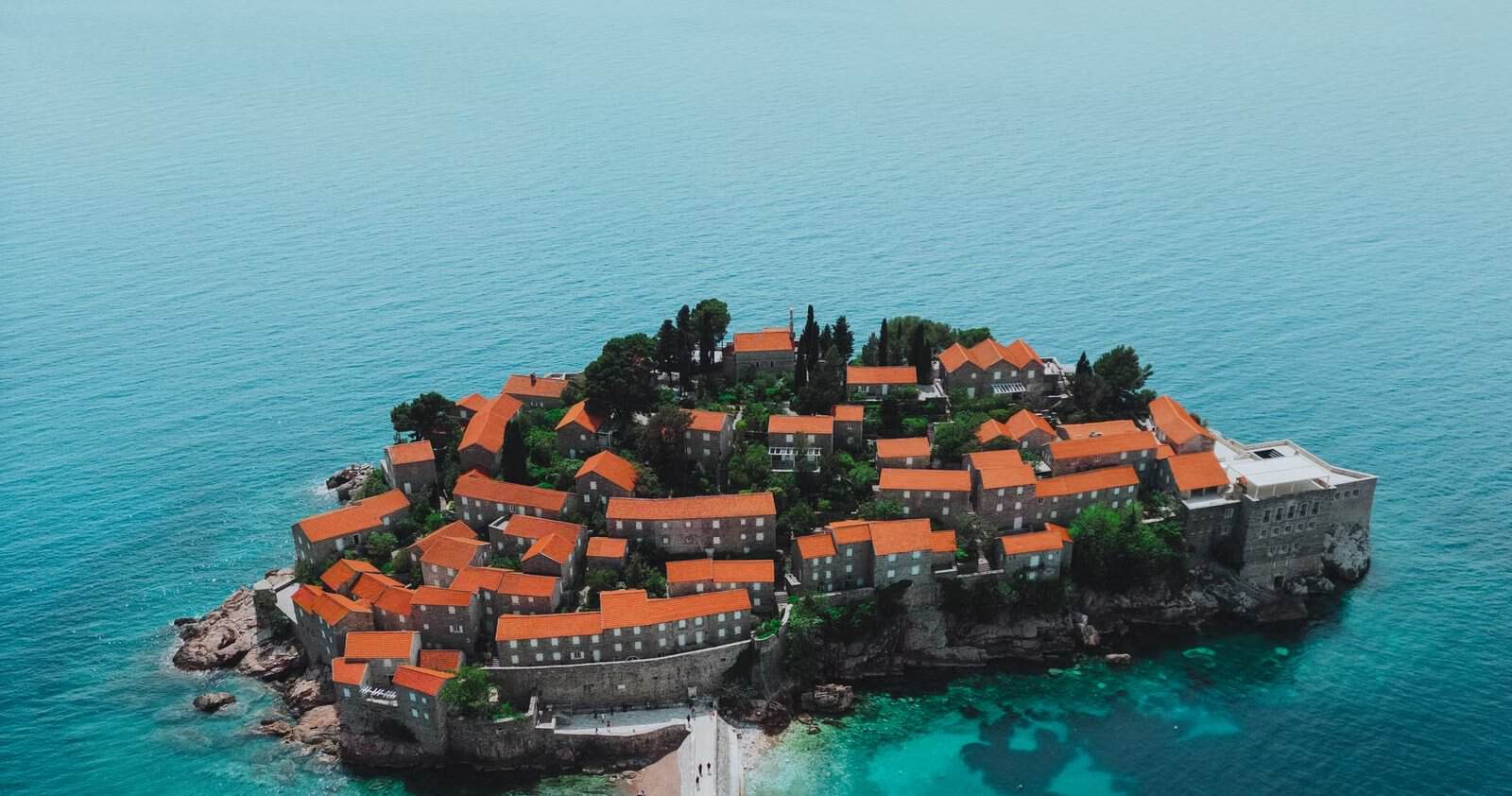
Sveti Stefan island on the Adriatic coast, Montenegro. Photo: Denis Sllovinja / Pexels
This Montenegro tax guide covers the rules in force for 2026. Montenegro pairs some of Europe’s lowest tax rates with unilateral use of the euro and front-runner EU-candidate status. Personal income tax is a gentle 0–15%, corporate tax is progressive at 9–15%, and a 2024 reform slashed social security — employers are now largely exempt and the employee burden fell to about 10.5%. VAT is 21%, there is no wealth tax, and a low cost of living rounds out the appeal.
Introduction
Montenegro is a small Balkan country on the Adriatic coast, bordered by Croatia, Bosnia and Herzegovina, Serbia, Kosovo and Albania, with a population of roughly 620,000. It is a parliamentary republic, a NATO member since 2017, and the front-runner in EU accession talks (targeting membership around 2028). Although not a eurozone member, it uses the euro unilaterally as its currency, removing exchange-rate risk for Western investors. The legal system is civil law, the official language is Montenegrin (Serbian, Bosnian, Albanian and Croatian are also recognised), and the climate is Mediterranean on the coast and alpine inland. With dramatic mountains, the Bay of Kotor and resort towns like Budva, plus a low cost of living well below Western Europe, it has become a magnet for tourists, second-home buyers and relocating entrepreneurs.
This Montenegro tax guide matters because the country offers EU-adjacent access, the euro and a Mediterranean lifestyle at strikingly low tax rates — a combination few European jurisdictions match. Personal income tax tops out at just 15% (plus a small municipal surtax), corporate tax runs 9–15%, and the October 2024 social-security reform cut the wage-tax wedge dramatically. Residency is straightforward via property ownership or company formation, and the country’s EU candidacy offers the prospect of single-market access down the line. The trade-offs — a small economy and governance concerns — are covered below.
Direct Taxes
Montenegro taxes individuals on a residence basis: residents are taxed on worldwide income, non-residents only on Montenegrin-source income. Residence broadly follows the 183-day rule or having a centre of vital interests in the country. Personal income tax is mildly progressive, with separate scales for employment and entrepreneurial income, plus a flat 15% on most other income categories and a small municipal surtax on top. Companies pay a progressive corporate tax. The signature draws for investors are the low headline rates and the post-2024 light social security.
Personal income tax (2026)
Employment income (gross, monthly):
| Monthly gross salary (EUR) | Rate |
|---|---|
| Up to 700 (≈ $756) | 0% |
| 700.01 – 1,000 (≈ $756 – 1,080) | 9% |
| Over 1,000 (≈ $1,080) | 15% |
Entrepreneurial / self-employment income (annual):
| Annual income (EUR) | Rate |
|---|---|
| Up to 8,400 (≈ $9,070) | 0% |
| 8,400.01 – 12,000 (≈ $9,070 – 12,960) | 9% |
| Over 12,000 (≈ $12,960) | 15% |
Employment income is taxed monthly on the bands above; the first EUR 700 (≈ $756) a month is tax-free. Most other personal income — rental, royalties, dividends, interest and capital gains — is taxed at a flat 15%. On top of PIT, a municipal surtax applies to the tax amount (not income): 13% in most municipalities, 15% in Podgorica and Cetinje — so the effective top rate is roughly 16.95–17.25%. These progressive bands replaced Montenegro’s old 9% flat tax in 2022.
Corporate income tax
| Taxable profit (EUR) | Rate |
|---|---|
| Up to 100,000 (≈ $108,000) | 9% |
| 100,000.01 – 1,500,000 (≈ $108,000 – 1,620,000) | €9,000 + 12% on excess over 100,000 |
| Over 1,500,000 (≈ $1,620,000) | €177,000 + 15% on excess over 1,500,000 |
Montenegro’s corporate tax is progressive at 9%, 12% and 15%, in force since 2022 (replacing the former 9% flat rate). The entry 9% rate — applying to profits up to EUR 100,000 — remains one of the lowest in Europe, and most SMEs never leave that band. Withholding tax of 15% generally applies to dividends, interest, royalties and certain service fees paid to non-residents, often reduced under Montenegro’s double-tax treaty network. As an EU candidate aligning with the acquis, Montenegro is expected to adopt OECD/EU minimum-tax norms over time, but no domestic Pillar Two top-up tax applies to ordinary companies yet — confirm current status for large groups.
Social security and health contributions
| Contribution | Employee | Employer |
|---|---|---|
| Pension & disability insurance | 10% | 0% |
| Unemployment insurance | 0.5% | 0.5% |
| Total | ≈10.5% | ≈0.5% |
The October 2024 reform transformed Montenegro’s payroll costs: employers were almost entirely exempted from social contributions, and the health-insurance contribution was abolished. Employees now bear pension and disability insurance at 10% (capped — the 2024 annual ceiling was EUR 68,765 / ≈ $74,300) plus 0.5% unemployment, with employers paying only a token 0.5%. This makes Montenegro’s total wage-tax wedge one of the lightest in Europe, a major draw for employers and the self-employed. Verify the current contribution cap and rates, which are still bedding in after the reform.
Indirect Taxes
Montenegro’s main indirect tax is a value-added tax modelled on the EU VAT Directive (part of its EU-accession alignment), supplemented by excise duties and real-estate transfer tax.
Value-added tax (VAT)
| Rate | Applies to (examples) |
|---|---|
| 21% (standard) | Most goods and services |
| 7% (reduced) | Basic foods, books, medicines, public water, tourism/accommodation, computers |
| 0% (zero) | Exports and international transport |
The standard VAT rate is 21%, with a 7% reduced rate on essentials and — importantly for a tourism economy — accommodation and hospitality. Exports are zero-rated. The VAT registration threshold is annual turnover of EUR 30,000 (≈ $32,400). The framework already follows EU VAT principles ahead of accession.
Excise and other indirect taxes
| Tax | Notes |
|---|---|
| Excise duties | On fuel, tobacco, alcohol and carbonated/sugary drinks, in line with EU excise structures. |
| Real-estate transfer tax | Progressive 3% / 5% / 6% on the purchase of existing property (by value band); new-build first sales fall under VAT instead. |
| Annual property tax | Municipal, 0.25%–1.0% of market value (higher rates for secondary/tourism property). |
Other Taxes Worth Knowing
| Tax | Montenegro treatment |
|---|---|
| Capital gains tax | 15% (individuals); company gains taxed within the 9–15% corporate base |
| Dividends (resident individual) | 15% |
| Interest (resident individual) | 15% |
| Rental income | 15% (flat) |
| Wealth / net worth tax | None |
| Inheritance / estate tax | 3% — close relatives (spouse, children) generally exempt |
| Gift tax | 3% — same close-relative exemption |
| Immovable property tax (annual) | Municipal, 0.25%–1.0% of market value |
The standout is the absence of a wealth tax and the very low rates elsewhere: capital gains, dividends, interest and rental income are all taxed at a flat 15%. Montenegro does levy inheritance and gift tax at 3%, but first-line relatives are generally exempt, so most family transfers pass tax-free. Annual property tax is a modest municipal charge (0.25%–1% of value), and buying existing property attracts a progressive 3–6% transfer tax. A typical investor living off capital income therefore faces a flat, predictable 15% — low by European standards.
Disadvantages & Risks
Montenegro is a small, tourism-dependent economy (the coast and hospitality drive a large share of GDP), which leaves it exposed to seasonal swings and external shocks, and its public debt is elevated relative to its size. The banking sector is small and concentrated, and the country has faced persistent concerns over corruption, organised crime and the rule of law — precisely the areas the EU is scrutinising in accession talks. Montenegro is a member of MONEYVAL (the Council of Europe’s AML body) and has worked to address deficiencies; it is not currently on the FATF grey list or the EU list of non-cooperative tax jurisdictions, but governance and money-laundering risk remain the central reputational issues. Frequent changes of government have also slowed reform.
For the tax-planner specifically, the risks are that the headline low rates could rise as EU accession forces fiscal and regulatory alignment, and that substance and transparency expectations are increasing — the days of treating Montenegro as a lightly-regulated backwater are ending. The citizenship-by-investment programme that once drew investors closed at the end of 2022, so residency (not a fast passport) is now the route in. Anyone relying on Montenegrin residence to break ties with a higher-tax home must ensure they genuinely meet the 183-day and centre-of-interests tests, as origin countries increasingly challenge thin relocations.
Strategy & Ideal Profile
The structures that work best combine Montenegrin tax residency with a local company for active income. A resident company pays just 9% on profits up to EUR 100,000, and — thanks to the 2024 reform — hiring is cheap because employers pay almost no social security. Owner-managers typically draw a modest salary (taxed at 0–15% with light contributions) and distribute profits as dividends taxed at 15%, giving a low all-in rate on business income. For the internationally mobile, simply becoming resident — readily achieved by buying property or forming a company and spending 183 days — captures the flat 15% on worldwide investment income, with no wealth tax and only token social contributions.
Who does it suit? Company owners and entrepreneurs wanting a 9% entry corporate rate and Europe’s lightest payroll costs; investors and traders content with a flat 15% on capital gains and dividends and no wealth tax; remote workers and the self-employed who benefit from the tax-free first slices of income and cheap living; and retirees and second-home buyers drawn by the euro, the Adriatic lifestyle and low property taxes. The practical residency rule is 183 days plus a genuine home or business in the country — straightforward to satisfy for those who actually relocate.
Who does it not suit? Those seeking a zero-tax outcome will still pay 9–15%, more than a Gulf or pure-territorial jurisdiction. Anyone needing a deep, sophisticated banking and professional ecosystem, or an unimpeachable top-tier reputation, may find Montenegro’s small market and governance profile limiting. And anyone hoping for a fast passport has missed the window — the citizenship-by-investment scheme has closed, and only residency remains. EU accession may also gradually erode the low-tax edge as alignment proceeds.
FAQ
Is Montenegro a tax haven?
No. Montenegro levies real taxes — 9–15% corporate, 0–15% personal, 21% VAT — and is an EU candidate aligning with EU tax and transparency norms. It is not on the EU list of non-cooperative jurisdictions or the FATF grey list. It is best described as a low-tax European country, not a zero-tax haven, with the euro and a Mediterranean lifestyle as added draws.
What is the corporate tax rate in Montenegro in 2026?
Corporate tax is progressive: 9% on profits up to EUR 100,000 (≈ $108,000), 12% on the slice to EUR 1.5 million, and 15% above that. The 9% entry rate is among the lowest in Europe and covers most small and medium companies.
How does Montenegro’s social security work after the 2024 reform?
Since October 2024, employers are almost entirely exempt from social contributions and the health contribution was abolished. Employees pay 10% pension and disability (capped) plus 0.5% unemployment — about 10.5% total — making Montenegro’s wage-tax wedge one of the lightest in Europe.
What is the 183-day rule in Montenegro?
You are generally a tax resident if you spend at least 183 days in Montenegro in a year, or have your centre of vital interests there. Residents are taxed on worldwide income; non-residents only on Montenegrin-source income.
Does Montenegro tax capital gains?
Yes, but lightly. Capital gains realised by individuals are taxed at a flat 15%; gains made by companies are folded into the 9–15% corporate base. There is no separate higher CGT rate.
Is there inheritance or wealth tax in Montenegro?
There is no wealth tax. Inheritance and gift tax exists at 3%, but first-line relatives (spouse, children, parents) are generally exempt, so most family transfers are tax-free.
How are dividends taxed for a non-resident investor?
Dividends paid to non-residents are subject to a 15% withholding tax, frequently reduced (commonly to 5–10%) under Montenegro’s double-tax treaties. Resident individuals are also taxed on dividends at 15%.
Sources
All figures should be checked against the primary government sources below.
- Uprava prihoda i carina (Revenue and Customs Administration of Montenegro) — income tax, VAT, withholding and excise — https://www.uprava.gov.me
- Ministarstvo finansija (Ministry of Finance of Montenegro) — tax policy, 2024 social-security reform, budget — https://www.gov.me/mif
- Fond penzijskog i invalidskog osiguranja (Pension & Disability Insurance Fund) — social contribution rates and caps — https://www.fondpio.me
- Sl. list Crne Gore (official gazette) — Personal Income Tax Law, Corporate Profit Tax Law, VAT Law — https://www.sluzbenilist.me
Last verified: 14 June 2026.
This is general information, not personal tax or legal advice. Tax outcomes depend on your specific facts; consult a qualified Montenegro tax adviser before acting.
Related guides: Andorra · Argentina · Australia · Bahamas · Botswana · Brunei · Bulgaria · Ceuta and Melilla · Chile · China · Costa Rica · Cyprus · Denmark · Dominican Republic · El Salvador · Estonia · Florida · Georgia · Gibraltar · Greece · Hawaii · Hong Kong · Iceland · Indonesia · Isle of Man · Italy · Jersey · Kuwait · Latvia · Macau · Malta · Mauritius · Monaco · Morocco · New Zealand · Panama · Paraguay · Philippines · Portugal · Puerto Rico · Romania · Sark · Seychelles · Singapore · South Korea · Taiwan · Thailand · Ticino · UAE · Uruguay · Zug