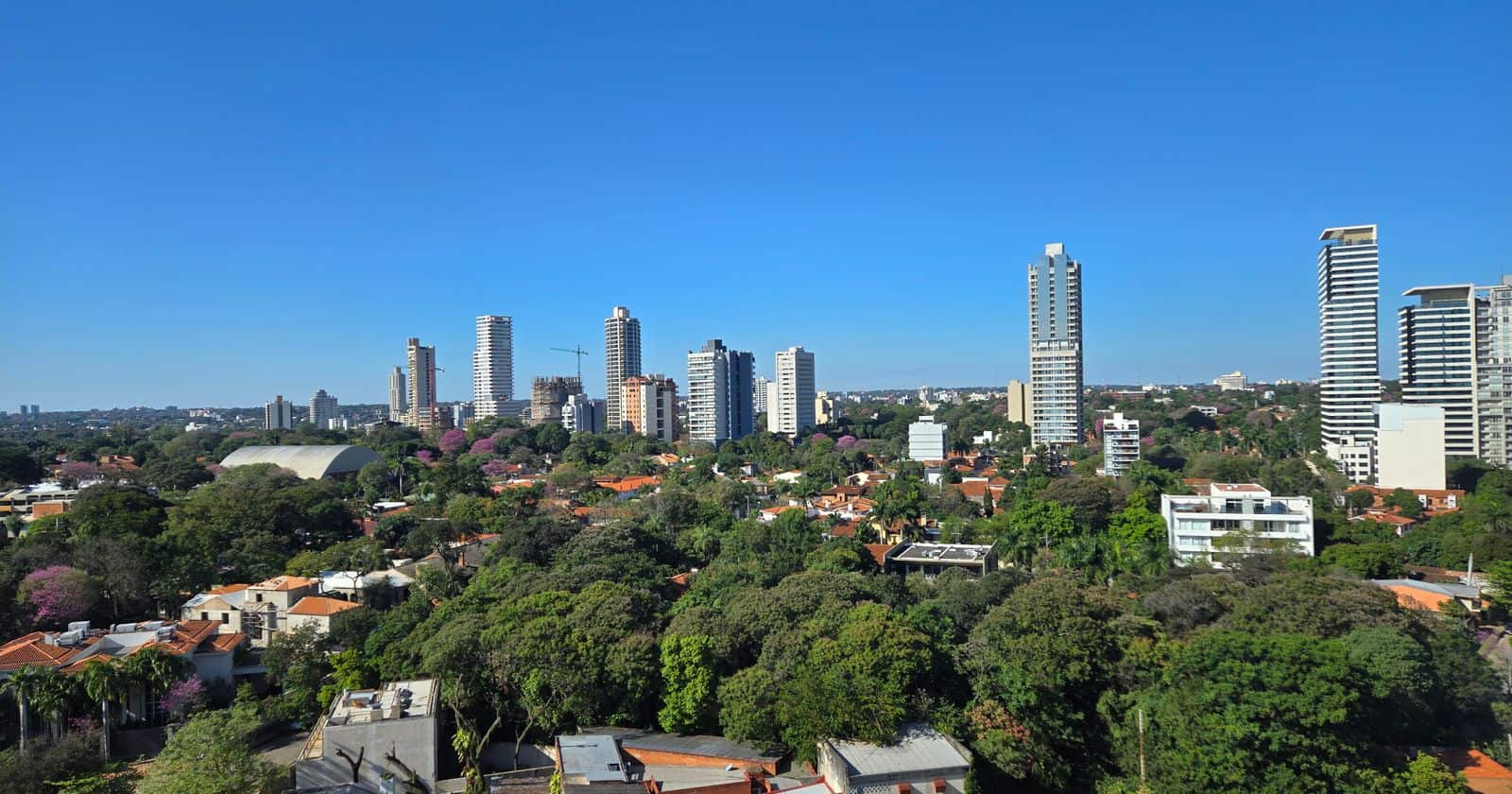
An aerial view of the Asunción skyline, Paraguay. Photo: Kevin Early / Pexels
This Paraguay tax guide covers the rules in force from 1 January 2026 under Law No. 6380/19. Paraguay runs a purely territorial system: only Paraguayan-source income is taxed, so foreign dividends, capital gains, pensions and online income are taxed at 0%. Headline rates are among the lowest in the Americas — a flat 10% corporate tax (IRE), 10% standard VAT (IVA), and a gentle 8–10% personal income tax (IRP). There is no wealth, inheritance or gift tax. Add some of the cheapest farmland and living costs on the continent, and the relocation case becomes clear.
Introduction
Paraguay is a landlocked country in the heart of South America, bordered by Argentina, Brazil and Bolivia, with Asunción — one of the oldest cities on the continent — as its capital. It is a presidential republic with a stable, market-friendly government, a young population of roughly 6.9 million, and Spanish and Guaraní as co-official languages. The climate is subtropical, the economy is anchored in agriculture, cattle, soy and hydroelectric power (Itaipú makes Paraguay one of the world’s largest exporters of clean energy), and the legal system is Spanish-influenced civil law. Crucially for the internationally mobile, the cost of living is among the lowest in the Americas: a single person lives comfortably in Asunción on roughly USD 935 a month including housing, and a one-bedroom city-centre apartment rents for around USD 490. Rural land is cheaper still — a point we return to below.
This Paraguay tax guide matters because the country pairs that low cost base with a genuinely territorial tax system and an unusually accessible permanent-residency route. Where most “low-tax” jurisdictions tax residents on worldwide income and then carve out exceptions, Paraguay simply does not reach foreign-source income at all — there is no remittance trap and no non-dom timer to run down. Combined with flat 10% headline rates, the absence of wealth and inheritance taxes, and farmland that can be bought for a few hundred dollars a hectare, Paraguay has become a serious option for entrepreneurs, remote earners, agricultural investors and retirees seeking a low-tax base with real on-the-ground affordability.
Direct Taxes
Paraguay taxes individuals and companies on a source basis only — residents and non-residents alike are taxable solely on Paraguayan-source income, and foreign-source income falls entirely outside the net. Personal income tax (IRP) is mildly progressive on local earnings; corporate income tax (IRE) is a single flat rate; and distributed profits face a separate dividend tax (IDU). The signature concept for any investor to grasp is territoriality: it is the foundation on which every other number in this guide sits.
Personal income tax (2026 bands)
| Chargeable income (PYG) | Rate |
|---|---|
| Up to 50,000,000 (≈ up to $6,800) | 8% |
| 50,000,001 – 150,000,000 (≈ $6,800–20,500) | 9% |
| Over 150,000,000 (≈ over $20,500) | 10% |
These IRP bands apply only to Paraguayan-source income from personal services, and tax is assessed on net income after deductible expenses. Taxpayers whose gross income from personal services does not exceed PYG 80 million (roughly USD 11,000) in the year are not required to pay IRP at all. At June 2026 exchange rates the bands translate to roughly USD 6,800, USD 20,500 and above. Capital income — interest, royalties, rents and capital gains — is taxed separately at a flat 8%. Foreign-source personal income is not taxed.
Corporate income tax
| Item | Rate |
|---|---|
| Standard corporate income tax (IRE), from 1 Jan 2020 | 10% |
| IRE SIMPLE (small businesses, gross turnover under ≈PYG 2 billion / ≈$270,000) | 3% on gross revenue |
| Dividend & profits tax (IDU) — resident recipient | 8% |
| Dividend & profits tax (IDU) — non-resident recipient | 15% |
Paraguay’s flat 10% IRE replaced the older corporate regime under the 2019 reform (Law 6380/19) and applies only to Paraguayan-source profit. Small businesses and many sole traders can elect IRE SIMPLE, paying 3% on gross income with minimal accounting. A separate IDU is charged when profits are distributed — 8% to residents, 15% to non-residents — so the effective top-end burden on a distributed local profit is roughly 17–23%. There is no specific IP-box regime, but generous incentive laws (notably the maquila regime and Law 60/90) can cut effective rates dramatically for qualifying export and investment projects.
Social security and health contributions
| Contribution | Employee | Employer | Self-employed |
|---|---|---|---|
| IPS (commercial entity) | 9.0% | 16.5% | Generally optional |
| IPS (financial entity) | 11.0% | 17.0% | Generally optional |
Social security contributions go to the Instituto de Previsión Social (IPS) and fund pensions and healthcare. For a standard commercial employer the combined rate is 25.5% of gross salary (9% withheld from the employee, 16.5% paid by the employer); financial-sector employers pay a combined 28%. Contributions are calculated on every wage item except the mandatory annual bonus and family allowance. For independent roles such as directors, administrators and managers, IPS contribution is optional — a meaningful point for owner-managers who draw income through dividends rather than payroll.
Indirect Taxes
Paraguay’s main indirect tax is a value-added tax (IVA) levied on goods and services supplied within the country, alongside selective excise duties. Rates are low by regional standards and the system is straightforward.
Value-added tax (VAT)
| Rate | Applies to (examples) |
|---|---|
| 10% (standard) | Most goods and services |
| 5% (reduced) | Basic food basket, pharmaceuticals, agricultural products, residential property rental and real-estate sales |
| 0% (zero) | Exports |
The standard IVA rate is 10%, with a reduced 5% band covering essentials — staple foods, medicines, agricultural goods and residential property. Exports are zero-rated and exporters can reclaim input VAT credits, typically within 90 business days. The reduced rate on the basic basket keeps everyday consumption cheap, reinforcing the country’s low cost of living.
Excise and other indirect taxes
| Tax | Notes |
|---|---|
| Excise duty (ISC, Impuesto Selectivo al Consumo) | Levied on fuel, tobacco, alcohol, sugary drinks and selected luxury goods; rates vary by product. |
| Customs duties | Apply to imports under the Mercosur common external tariff. |
| Property transfer costs | Notary and registration fees on real-estate transfers; no separate national stamp duty on most transactions. |
Other Taxes Worth Knowing
| Tax | Paraguay treatment |
|---|---|
| Capital gains tax | Taxed as capital income at 8% (IRP) where Paraguayan-source; foreign-source gains 0% |
| Dividends (resident individual) | 8% IDU |
| Dividends (non-resident) | 15% IDU |
| Interest (resident individual) | 8% (capital income) |
| Rental income | Taxable; 5% VAT plus IRP capital income at 8% |
| Wealth / net worth tax | None |
| Inheritance / estate tax | None |
| Gift tax | None |
| Immovable property tax (annual) | ≈1% of cadastral value, levied by municipalities |
The headline here is what is missing: Paraguay levies no wealth tax, no inheritance or estate tax, and no gift tax, so capital can pass between generations without a transfer charge. The only recurring property levy is the municipal immovable property tax at roughly 1% of the official cadastral value — and because cadastral values are typically set well below market value, the cash amount paid on a home or a farm is usually very small. A foreign investor living off overseas dividends and capital gains can, structured correctly, pay close to 0% in Paraguay on that income.
Disadvantages & Risks
Paraguay is not a polished offshore centre, and the trade-offs are real. The economy is small and concentrated in agriculture and energy, which makes it sensitive to commodity prices, drought and the fortunes of its giant neighbours, Argentina and Brazil; currency and regional volatility can spill across the border. The banking sector is shallow by international standards, opening accounts can be slow and document-heavy, and English is far from universal in officialdom — most administration runs in Spanish. Infrastructure outside Asunción and Ciudad del Este is patchy, and bureaucracy can be slow and informal.
On the reputational side, Paraguay has faced scrutiny over AML and informality, and has periodically appeared on enhanced-monitoring lists; it is not currently on the EU list of non-cooperative tax jurisdictions, but investors should verify current status before relying on it. Tax residence itself carries nuance: the widely repeated “120-day” rule actually describes civil-law domicile rather than a statutory tax-residence test, so the practical question of when Paraguay treats you as resident — and whether your former country still claims you — should be confirmed with a local adviser. Finally, the territorial benefit only protects foreign-source income; genuinely Paraguayan earnings are fully taxable, and substance matters if you want local structures respected abroad.
Strategy & Ideal Profile
The structures that work best in Paraguay lean on the territorial principle. A common setup pairs permanent residency (Paraguay’s residency-by-investment and ordinary routes are among the cheapest and fastest in the region) with income arranged to be foreign-source — overseas dividends, trading gains, SaaS revenue or pensions — so it lands in the 0% bracket. Owner-managers of a local Paraguayan company often draw profit as dividends (8% IDU) rather than salary to sidestep payroll IPS, while small operating businesses use IRE SIMPLE at 3% of gross. For agricultural investors, the combination of cheap land, a 10% IRE and a 5% VAT on agricultural goods is the core attraction.
Who does it suit? Company owners and entrepreneurs wanting a 10% flat corporate base; investors and traders living off foreign capital income that Paraguay simply does not tax; dividend earners and retirees whose income arrives from abroad and is therefore untaxed locally; and agricultural and land investors drawn by farmland that is genuinely cheap — raw Chaco land from roughly USD 50–600 a hectare, developed eastern farmland around USD 1,500–5,000, and prime soy or corn ground USD 6,000–12,000. Against the regional norm of USD-denominated cropland many times that price, Paraguay is an outlier, and the low cost of living means a modest foreign income stretches a long way. Practical residency typically means establishing genuine domicile and spending meaningful time in-country.
Who does it not suit? Anyone whose income is unavoidably Paraguayan-source gains nothing from territoriality and pays the full local rates. Those who need a deep, sophisticated banking and professional-services ecosystem, frictionless English-language administration, or an unimpeachable “tier-one” jurisdiction label may find Paraguay too rough around the edges. And anyone hoping to keep tax residence elsewhere while claiming Paraguayan benefits should be cautious: the headline 0% only works if you genuinely break ties with your former tax home.
FAQ
Is Paraguay a tax haven?
Not in the classic zero-tax sense. Paraguay does levy income tax, VAT and corporate tax — but at flat 10% headline rates and on a strictly territorial basis, so foreign-source income is untaxed. It is better described as a low-tax, territorial jurisdiction than a true tax haven.
What is the corporate tax rate in Paraguay in 2026?
The standard corporate income tax (IRE) is a flat 10% on Paraguayan-source profit. Small businesses can elect IRE SIMPLE at 3% of gross revenue. Distributed profits face a separate dividend tax (IDU) of 8% for residents or 15% for non-residents.
How does Paraguay’s territorial tax system work?
Paraguay taxes only income sourced within Paraguay. Foreign dividends, interest, capital gains, pensions and online income earned outside the country are taxed at 0%, regardless of whether you remit them. There is no worldwide-income charge and no remittance rule.
What is the Paraguay tax residency rule?
Permanent residency is straightforward to obtain, but tax residence turns on domicile rather than a simple day count. The often-cited “120-day” figure actually refers to civil-law domicile, not a statutory tax test. In practice you should establish genuine domicile and confirm your position — and your exit from any prior tax home — with a local adviser.
Does Paraguay tax capital gains?
Paraguayan-source capital gains are taxed as capital income at a flat 8%. Foreign-source capital gains are not taxed at all under the territorial system.
Is there inheritance or wealth tax in Paraguay?
No. Paraguay has no inheritance or estate tax, no gift tax and no wealth or net-worth tax. The only recurring property levy is a municipal immovable property tax of about 1% of cadastral value, which is usually small in cash terms.
How are dividends taxed for a non-resident investor?
Dividends paid out of Paraguayan company profits to a non-resident are subject to the dividend tax (IDU) at 15% (versus 8% for residents). Dividends a Paraguayan resident receives from abroad are foreign-source and taxed at 0%.
Sources
All figures should be checked against the primary government sources below.
- Subsecretaría de Estado de Tributación (SET), Dirección Nacional de Ingresos Tributarios (DNIT) — Paraguay tax authority: IRP, IRE, IVA, IDU and Law 6380/19 — https://www.dnit.gov.py
- Ministerio de Economía y Finanzas (MEF) — fiscal policy and tax reform legislation — https://www.mef.gov.py
- Instituto de Previsión Social (IPS) — social security contribution rates — https://www.ips.gov.py
- Biblioteca y Archivo Central del Congreso Nacional — full text of Law No. 6380/19 (tax modernisation) — https://www.bacn.gov.py
Last verified: 14 June 2026.
This is general information, not personal tax or legal advice. Tax outcomes depend on your specific facts; consult a qualified Paraguay tax adviser before acting.
Related guides: Andorra · Argentina · Australia · Bahamas · Botswana · Brunei · Bulgaria · Ceuta and Melilla · Chile · China · Costa Rica · Cyprus · Denmark · Dominican Republic · El Salvador · Estonia · Florida · Georgia · Gibraltar · Greece · Hawaii · Hong Kong · Iceland · Indonesia · Isle of Man · Italy · Jersey · Kuwait · Latvia · Macau · Malta · Mauritius · Monaco · Montenegro · Morocco · New Zealand · Panama · Philippines · Portugal · Puerto Rico · Romania · Sark · Seychelles · Singapore · South Korea · Taiwan · Thailand · Ticino · UAE · Uruguay · Zug