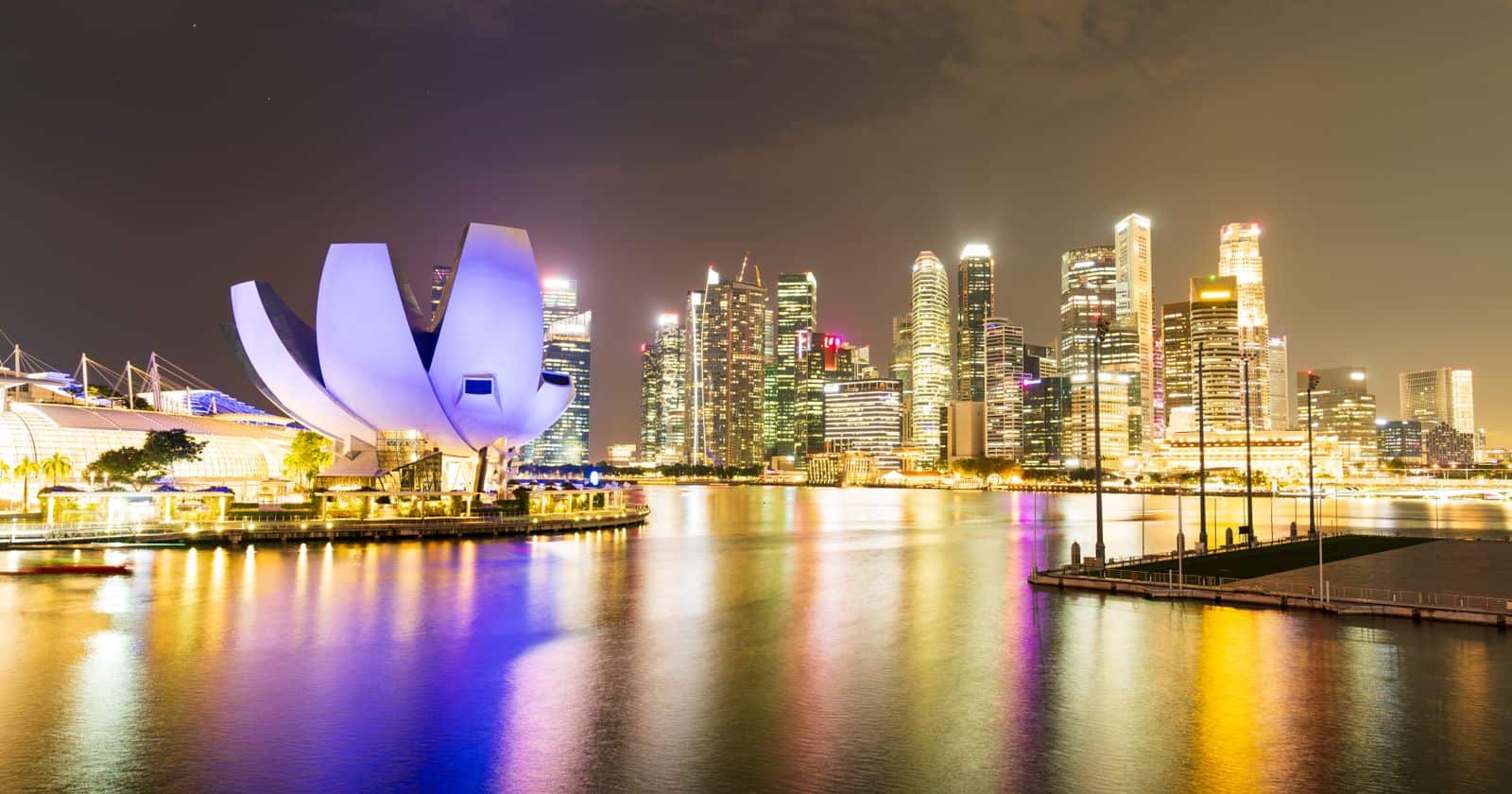
The Marina Bay skyline at night, Singapore. Photo: Mark Baldovino / Pexels
This Singapore tax guide covers the rules in force for the 2026 year of assessment (income year 2025). Singapore runs a quasi-territorial system: income is taxed if it is sourced in — or received in — Singapore, and most foreign-source income is exempt. Resident individuals pay progressive rates of 0–24%, companies a flat 17%, and GST is 9%. There is no capital gains tax, no inheritance or estate tax, and no wealth tax. A 40% corporate tax rebate applies for YA 2026, and Pillar Two top-up tax now applies to the largest multinationals.
Introduction
Singapore is a city-state at the southern tip of the Malay Peninsula, comprising one main island and around 60 islets, strategically positioned on the Strait of Malacca between Malaysia and Indonesia. It is a parliamentary republic with one of the world’s most stable, business-friendly governments, a common-law legal system inherited from Britain, and four official languages (English, Mandarin, Malay and Tamil), with English the language of business and administration. The climate is tropical and the lifestyle intensely urban: Singapore is a global financial centre, a major port and aviation hub, and consistently ranks at the top for ease of doing business and rule of law. The trade-off is cost of living — Singapore is regularly rated among the most expensive cities on earth, with housing and cars especially pricey.
This Singapore tax guide matters because the country combines a low, simple tax system with unrivalled connectivity, political stability and a deep financial and professional ecosystem. Where many low-tax jurisdictions are small offshore islands, Singapore is a substantive, OECD-compliant onshore hub — taxes are genuinely modest rather than zero, and the appeal rests on the absence of capital, wealth and death taxes, the foreign-source income exemption, an extensive treaty network, and a 17% corporate rate softened by generous start-up reliefs. The headline 2026 changes are a 40% corporate income tax rebate (capped) and the rollout of the OECD Pillar Two 15% minimum tax for in-scope multinational groups from 1 January 2025.
Direct Taxes
Singapore taxes on a territorial, receipts basis: income is taxable if it accrues in or is derived from Singapore, or is received in Singapore from outside. Foreign-source income received by a resident individual is generally exempt (unless received through a Singapore partnership), and companies can exempt qualifying foreign dividends, branch profits and service income under the foreign-source income exemption. Individuals are taxed at progressive rates with reliefs; companies pay a flat 17%. Corporate residence turns on where control and management are exercised. The signature concept for investors is that capital is not taxed — only income.
Personal income tax (2026 bands)
| Chargeable income (SGD) | Rate on excess |
|---|---|
| 0 – 20,000 (≈ $0–14,800) | 0% |
| 20,000 – 30,000 (≈ $14,800–22,200) | 2% |
| 30,000 – 40,000 (≈ $22,200–29,600) | 3.5% |
| 40,000 – 80,000 (≈ $29,600–59,200) | 7% |
| 80,000 – 120,000 (≈ $59,200–88,800) | 11.5% |
| 120,000 – 160,000 (≈ $88,800–118,400) | 15% |
| 160,000 – 200,000 (≈ $118,400–148,000) | 18% |
| 200,000 – 240,000 (≈ $148,000–177,600) | 19% |
| 240,000 – 280,000 (≈ $177,600–207,200) | 19.5% |
| 280,000 – 320,000 (≈ $207,200–236,800) | 20% |
| 320,000 – 500,000 (≈ $236,800–370,000) | 22% |
| 500,000 – 1,000,000 (≈ $370,000–740,000) | 23% |
| Over 1,000,000 (≈ over $740,000) | 24% |
These resident rates apply from YA 2024 onwards, after the top marginal rate rose from 22% to 24% (with new 23% and 24% bands above S$500,000 and S$1,000,000) to enhance progressivity. The first S$20,000 of income is tax-free, and numerous personal reliefs further reduce the bill. Non-residents are taxed at a flat 24%, except employment income, which is taxed at the higher of 15% or the resident rates. Residence for individuals broadly requires 183 days of presence in the year.
Corporate income tax
| Item | Rate |
|---|---|
| Standard corporate income tax | 17% |
| New start-ups — first S$100,000 of chargeable income (first 3 YAs) | ≈4.25% effective (75% exempt) |
| New start-ups — next S$100,000 (first 3 YAs) | 8.5% effective (50% exempt) |
| Multinational groups in scope of Pillar Two (revenue ≥ €750m) | 15% minimum effective |
The corporate rate is a flat 17% on chargeable income, with no separate tax on capital gains or dividends. New companies enjoy a start-up exemption (75% of the first S$100,000 and 50% of the next S$100,000 exempt for the first three years), and all companies get a partial exemption thereafter. For YA 2026, a 40% CIT rebate (capped at S$40,000, with a minimum S$2,000 cash grant for active companies that employed staff in 2025) applies. From 1 January 2025, Singapore implemented an Income Inclusion Rule and Domestic Top-up Tax so that in-scope multinationals pay an effective 15% under OECD Pillar Two. One-tier system: dividends paid by Singapore companies are tax-exempt in shareholders’ hands.
Social security and health contributions
| Contribution (CPF, citizens & PRs only) | Employee | Employer | Self-employed |
|---|---|---|---|
| Central Provident Fund (age ≤ 55, on wages to the S$8,000/month ceiling) | 20% | 17% | MediSave only |
Singapore’s social security is the Central Provident Fund (CPF) — a mandatory savings scheme, not a tax, payable only by Singapore citizens and permanent residents. For those aged 55 and under, employees contribute 20% and employers 17% of ordinary wages, up to a monthly wage ceiling of S$8,000 (so maximum monthly contributions of S$1,600 and S$1,360 respectively). Foreign nationals and their employers cannot contribute to CPF — a significant point for expatriates, whose take-home pay is correspondingly higher. Employers also pay a small Skills Development Levy (0.25%, capped) and, for lower-skilled foreign hires, a Foreign Worker Levy.
Indirect Taxes
Singapore’s main indirect tax is the goods and services tax (GST), a broad-based value-added tax. Singapore is outside the EU, so GST operates under its own framework.
Goods and services tax (GST)
| Rate | Applies to (examples) |
|---|---|
| 9% (standard) | Most goods and services, and imported goods |
| 0% (zero) | Exports of goods and international services |
| Exempt | Prescribed financial services, residential property sale/rental, digital payment tokens, investment precious metals |
The standard GST rate is 9%, raised from 8% on 1 January 2024 (and from 7% the year before). It is low by global standards but is the one broad consumption tax residents feel daily. Exports and international services are zero-rated; residential property and most financial services are exempt. Businesses must register once taxable turnover exceeds S$1 million a year.
Excise and other indirect taxes
| Tax | Notes |
|---|---|
| Excise duties | On liquor, tobacco, motor vehicles and petroleum products; vehicles are heavily taxed (plus the COE quota system). |
| Buyer’s Stamp Duty (BSD) | Up to 6% on residential property, up to 5% on non-residential, on price or market value. |
| Additional Buyer’s Stamp Duty (ABSD) | Up to 65% — a property-cooling measure; highest for foreign buyers and multiple-property owners. |
| Seller’s Stamp Duty (SSD) | Up to 16% on residential property sold within the holding period (from 4 July 2025). |
| Share transfer duty | 0.2% on the price or value of shares transferred. |
Other Taxes Worth Knowing
| Tax | Singapore treatment |
|---|---|
| Capital gains tax | None |
| Dividends (resident individual) | 0% — one-tier system; Singapore dividends are tax-exempt |
| Interest (resident individual) | Taxable as income; most bank deposit interest is exempt |
| Rental income | Taxable at progressive rates (net of expenses) |
| Wealth / net worth tax | None |
| Inheritance / estate tax | None — estate duty abolished 15 February 2008 |
| Gift tax | None |
| Immovable property tax (annual) | Owner-occupied 0–32%; non-owner-occupied 12–36%; non-residential 10% of annual value |
The defining feature is what Singapore does not tax: there is no capital gains tax, so gains on shares, property and other assets are generally untaxed (though frequent property or share trading can be recharacterised as a taxable trade). There is no wealth tax, no gift tax, and no inheritance or estate tax — estate duty was abolished in 2008. Dividends from Singapore companies are tax-free in the shareholder’s hands under the one-tier system, and most local bank interest is exempt. The main recurring asset levy is property tax on annual value, which is progressive and deliberately higher for investment and luxury homes. A typical investor living off dividends and capital gains can therefore face a very low effective rate.
Disadvantages & Risks
Singapore is a small, open, trade-dependent economy acutely exposed to global cycles, supply-chain shocks and the health of China and the wider region — a downturn in world trade hits hard. The cost of living is among the highest in the world: residential property, private cars (via the COE system) and schooling are very expensive, which erodes the value of the low tax rates for families. Politically the city-state is stable but tightly governed, with limited political pluralism and strict social regulation that some find constraining. Talent and housing pressures have pushed up the cost of hiring foreigners through Foreign Worker Levies and tighter Employment Pass criteria, making relocation less frictionless than the tax headline suggests.
On the international front, Singapore is a reputable, well-regulated jurisdiction — it is not on the EU list of non-cooperative tax jurisdictions and scores well on FATF and OECD transparency reviews — but as a major wealth-management hub it attracts scrutiny over inbound flows and has tightened AML and family-office rules after high-profile money-laundering cases. The biggest structural change is OECD Pillar Two: from 2025 the largest multinational groups face a 15% minimum effective tax, eroding the value of Singapore’s 17% rate and incentive regimes for those groups, though smaller companies and individuals are unaffected. Substance requirements for incentives and family-office schemes have also risen.
Strategy & Ideal Profile
The structures that work best use Singapore as a substantive onshore hub rather than a brass-plate haven. A common pattern is a Singapore holding or headquarters company taxed at 17% (often far lower after start-up or incentive reliefs), holding regional operations and channelling tax-exempt one-tier dividends to shareholders, with qualifying foreign-source income exempted on remittance. High-net-worth families increasingly use the Single Family Office regime (Sections 13O/13U) to manage investments with concessionary treatment, subject to rising substance and spending conditions. For individuals, the appeal is direct: no capital gains tax, no tax on Singapore dividends, and a top personal rate of 24% that only bites above S$1 million.
Who does it suit? Company owners and entrepreneurs building a real regional base who benefit from 17%, start-up reliefs and the treaty network; investors and traders who pay zero on capital gains and Singapore dividends; fund managers and family offices using the 13O/13U regimes; and high-earning professionals, especially expatriates who escape CPF and keep more take-home pay. The practical residency rule is 183 days, after which progressive resident rates and reliefs apply. The system rewards genuine presence and substance, not paper structures.
Who does it not suit? Pure tax-minimisers seeking a zero-rate base will find Singapore charges real (if modest) tax and demands genuine substance — a Gulf or Caribbean zero-tax jurisdiction may suit them better. Large multinationals now face the 15% Pillar Two floor, neutralising some of the rate advantage. And cost-sensitive families may find that sky-high housing, car and schooling costs offset much of the tax saving. Singapore is optimal when you want a credible, well-connected onshore base with low capital taxes — not the rock-bottom rate of an offshore island.
FAQ
Is Singapore a tax haven?
No, not in the classic sense. Singapore levies real taxes — 17% corporate, up to 24% personal, 9% GST — and is an OECD-aligned, transparent jurisdiction not on the EU non-cooperative list. Its appeal is low rates plus the absence of capital gains, wealth and inheritance taxes, a foreign-income exemption and a wide treaty network, within a substantive onshore economy.
What is the corporate tax rate in Singapore in 2026?
A flat 17% on chargeable income, with start-up and partial exemptions that lower the effective rate for smaller companies. A 40% CIT rebate (capped at S$40,000) applies for YA 2026. Multinational groups with revenue of €750m or more face a 15% minimum under Pillar Two from 2025.
How does Singapore’s territorial tax system work?
Income is taxed if it is sourced in Singapore or received in Singapore. Foreign-source income received by a resident individual is generally exempt (unless via a Singapore partnership), and companies can exempt qualifying foreign dividends, branch profits and service income under Section 13(8), subject to conditions.
What is the 183-day rule in Singapore?
An individual is generally treated as tax-resident for a year of assessment if they are physically present or employed in Singapore for at least 183 days in the preceding calendar year. Residents pay progressive 0–24% rates with reliefs; non-residents are taxed at a flat 24% (15% or resident rates on employment income).
Does Singapore tax capital gains?
No. Singapore has no capital gains tax, so gains on shares, property and other investments are generally untaxed. However, gains from activity that amounts to trading (e.g. frequent property flipping) can be assessed as taxable income.
Is there inheritance or wealth tax in Singapore?
No. Singapore has no inheritance or estate tax (estate duty was abolished on 15 February 2008), no gift tax and no wealth tax. The main recurring asset charge is annual property tax on a property’s annual value.
How are dividends taxed for a non-resident investor?
Dividends paid by a Singapore company are tax-exempt under the one-tier system — for residents and non-residents alike — and Singapore imposes no withholding tax on dividends. Non-residents are otherwise taxed only on Singapore-source income, with withholding tax on certain payments such as interest and royalties.
Sources
All figures should be checked against the primary government sources below.
- Inland Revenue Authority of Singapore (IRAS) — individual and corporate income tax rates, GST, property tax, stamp duty — https://www.iras.gov.sg
- Central Provident Fund Board (CPF) — CPF contribution rates and wage ceilings — https://www.cpf.gov.sg
- Ministry of Finance (MOF) / Singapore Budget — CIT rebate, Pillar Two, Budget 2026 measures — https://www.mof.gov.sg
- Singapore Statutes Online (AGC) — Income Tax Act 1947 and Goods and Services Tax Act — https://sso.agc.gov.sg
Last verified: 14 June 2026.
This is general information, not personal tax or legal advice. Tax outcomes depend on your specific facts; consult a qualified Singapore tax adviser before acting.
Related guides: Andorra · Argentina · Australia · Bahamas · Botswana · Brunei · Bulgaria · Ceuta and Melilla · Chile · China · Costa Rica · Cyprus · Denmark · Dominican Republic · El Salvador · Estonia · Florida · Georgia · Gibraltar · Greece · Hawaii · Hong Kong · Iceland · Indonesia · Isle of Man · Italy · Jersey · Kuwait · Latvia · Macau · Malta · Mauritius · Monaco · Montenegro · Morocco · New Zealand · Panama · Paraguay · Philippines · Portugal · Puerto Rico · Romania · Sark · Seychelles · South Korea · Taiwan · Thailand · Ticino · UAE · Uruguay · Zug