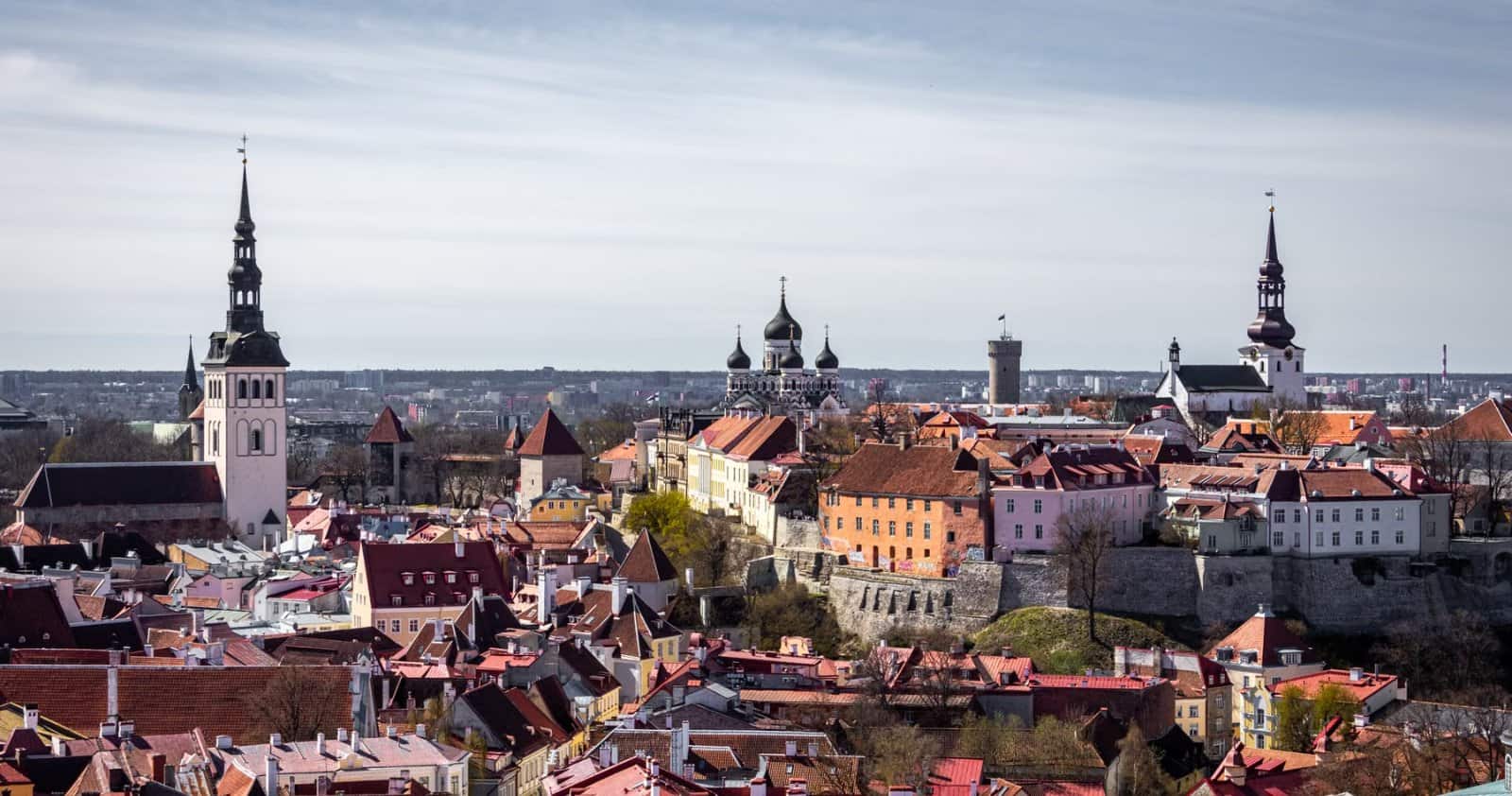
This Estonia tax guide covers the rules in force from 1 January 2026. Estonia taxes corporate profits only when they are distributed — retained and reinvested earnings face 0%, and dividends are taxed at 22/78 of the net amount. Personal income tax is a flat 22%, with a universal €700 (~$805) monthly basic exemption replacing the old income-tapered allowance. VAT is 24%. There is no wealth, inheritance or gift tax. The planned rise of both income tax rates to 24% was cancelled by the Riigikogu in December 2025.
Introduction
Estonia is the northernmost Baltic state, sharing a 294-kilometre land border with Russia and facing Finland across the Gulf of Finland. It has been an EU and NATO member since 2004, is in the eurozone and Schengen, and operates a civil-law system with strong German and Nordic influence. Politics are stable but coalition-driven, and the country is firmly Atlanticist. English is widely spoken in Tallinn and across the tech sector, though Estonian is the sole official language, and the climate is cold and continental. Living costs sit well below Western European levels, and the public administration is the most digitised in Europe — company formation, tax filing and banking are done entirely online.
For internationally-mobile founders, this Estonia tax guide matters because of one structural feature no other EU state offers at scale: corporate income tax is deferred until profit leaves the company, so a business can compound capital indefinitely at a 0% effective rate. Layered on that are a flat 22% personal income tax, no corporate-level capital gains tax until distribution, no wealth or inheritance tax, and the e-Residency programme, which lets a non-resident found and run an Estonian company remotely — over 135,000 e-residents have registered since 2014 and they own more than 39,000 Estonian companies. Recent reform has trimmed the advantage rather than removed it: income tax rose from 20% to 22% on 1 January 2025, VAT from 22% to 24% on 1 July 2025, and a temporary “security tax” was legislated in December 2024 then repealed on 19 June 2025 before taking effect. A permanent rise of both income tax rates to 24% was enacted in mid-2025 and cancelled in December 2025 — so 22% stands for 2026.
Direct Taxes
Estonian residents are taxed on worldwide income; non-residents only on Estonian-source income. There is no progressivity — a single 22% applies to all personal income above the basic exemption. A company is resident if it is registered in Estonia, making corporate residence a formality rather than a management-and-control test. The signature concept is the distribution-based corporate income tax: Estonia does not tax accounting profit at all. It taxes distributions — dividends, buybacks, capital reductions, liquidation proceeds, fringe benefits, gifts and expenses unrelated to business.
Personal income tax (2026 bands)
| Chargeable income (EUR, USD) | Rate |
|---|---|
| Up to €8,400 / year (~$9,660) — basic exemption | 0% |
| Above €8,400 / year (~$9,660) | 22% |
| Pensionable-age basic exemption: up to €9,312 / year (~$10,700) | 0% |
| Business income paid into an entrepreneur account | 20% |
The flat 22% has applied since 1 January 2025, replacing 20%. The real 2026 change is the basic exemption: from 1 January 2026 it is a universal €700 per month / €8,400 per year (~$805 / ~$9,660) and no longer tapers away as income rises — the “tax hump” that stripped the allowance from higher earners has been abolished. Those at pensionable age get €776 per month / €9,312 per year (~$892 / ~$10,700), applied automatically; everyone else must apply in writing to their employer. Employer spending on employee health and sport is exempt up to €400 (~$460) per person per year. The entrepreneur account — a simplified regime for small-scale self-employment — was due to rise to 22% but stayed at 20% in the December 2025 reversal.
Corporate income tax
| Item | Rate |
|---|---|
| Retained and reinvested profits | 0% |
| Distributed profits (from 1 Jan 2025) | 22/78 of the net distribution — 22% of the gross, ~28.2% of the net amount paid |
| Distributed profits (to 31 Dec 2024) | 20/80 |
| Reduced rate on regular dividends (abolished 1 Jan 2025) | formerly 14/86 |
| Legacy withholding on redistributed pre-2025 14/86 dividends to individuals | 7% |
| Withholding tax on dividends to non-residents | 0% |
| Credit institutions — quarterly advance CIT on accounting profit (from 1 Jan 2025) | 18% (was 14%) |
| Fringe benefits, gifts, non-business expenses | 22/78 (fringe benefits also bear 33% social tax) |
The mechanics are the point: a company earning €1,000,000 (~$1,150,000) and reinvesting it pays nothing; distributing the same sum costs €220,000 (~$253,000). The reduced 14/86 rate on regular dividends was abolished on 1 January 2025 along with the 7% withholding on dividends to individuals, leaving only the flat 22/78 and a narrow legacy 7% charge where pre-2025 dividends taxed at 14/86 are redistributed to a natural person. A participation exemption lets dividends received from Estonian, EU, EEA or Swiss subsidiaries — or from any foreign company where the Estonian holder has at least 10% and the profits were taxed abroad — flow through and out again free of Estonian tax; this is what makes the Estonian holding company work. Estonia holds an EU derogation postponing Pillar Two to 2030, so groups above the €750 million (~$860 million) consolidated-revenue threshold currently face information obligations rather than a top-up tax here. Loss carry-forward is irrelevant, since profit itself is never taxed.
Social security and health contributions
| Contribution | Employee | Employer | Self-employed |
|---|---|---|---|
| Social tax (pension + health insurance) | — | 33% | 33% |
| Unemployment insurance | 1.6% | 0.8% | — |
| Mandatory funded pension (II pillar) | 2%, 4% or 6% (elective) | — | — |
Social tax is uncapped — there is no ceiling above which the 33% stops, and that is the single biggest cost of high-salary employment in Estonia. There is a floor instead: the minimum monthly base for 2026 is €886 (~$1,020), giving a minimum employer liability of €292.38 (~$336) per employee per month, payable even where actual pay is lower. The default funded-pension rate is 2%; employees may elect 4% or 6%, changeable once a year. The statutory minimum wage rose to €946 per month / €5.67 per hour (~$1,090 / ~$6.52) from 1 April 2026, up from €886 (~$1,020). Fringe benefits are taxed in the employer’s hands at 22/78 plus 33% social tax, so non-cash remuneration is expensive.
Indirect Taxes
Estonia applies the EU VAT Directive framework, and VAT is by a wide margin the state’s largest single revenue source — a deliberate design choice, since taxing consumption rather than corporate profit is what funds the deferral system.
Value-added tax (VAT)
| Rate | Applies to (examples) |
|---|---|
| 24% (standard) | Most goods and services — raised from 22% on 1 July 2025 |
| 13% (reduced) | Accommodation and accommodation with breakfast — raised from 9% on 1 January 2025 |
| 9% (reduced) | Books, periodicals and press publications (up from 5% on 1 January 2025), certain medicines and medical devices |
| 0% (zero) | Exports, intra-EU supplies of goods, international transport |
Registration is compulsory once taxable turnover exceeds €40,000 (~$46,000) in a calendar year, with the application due within three working days of crossing it; voluntary registration is available below. Returns are monthly, filed by the 20th. At 24% the standard rate is the highest in the Baltics and among the higher rates in the EU — a real cost for consumer-facing businesses, and the reason a B2B service exporter is structurally advantaged.
Excise and other indirect taxes
| Tax | Notes |
|---|---|
| Alcohol and tobacco excise | Rates rose 10% on 1 January 2026, with further 5% rises scheduled for 2027 and 2028 |
| Fuel excise | Rising 5% annually on 1 May from 2026 to 2028 — unleaded petrol went to €621 per 1,000 litres (~$715) from €591 (~$680) |
| Electricity and gas excise | Increased on the same 1 May schedule |
| Motor vehicle registration fee | One-off on first registration or change of owner: base part €150 (~$173) for passenger cars, €300 (~$345) for vans (€200 / ~$230 fully electric), plus CO₂ and mass components |
| Property transfer | No stamp duty; notary fees and a state registration fee apply, both modest and scaled to transaction value |
Other Taxes Worth Knowing
| Tax | Estonian treatment |
|---|---|
| Capital gains tax (individuals) | No separate CGT — gains on shares, property, crypto and other assets are ordinary income at 22%. Sale of one’s own home is exempt |
| Capital gains (companies) | 0% until distributed — a gain realised inside an Estonian company is simply retained profit |
| Investment account regime | Optional deferral: tax on qualifying securities income is postponed until withdrawals exceed contributions |
| Dividends (resident individual) | No further personal tax — taxed at company level at 22/78. Legacy exception: 7% on redistributed pre-2025 14/86 dividends |
| Dividends (non-resident) | 0% withholding tax since 1 January 2025 |
| Interest (resident individual) | 22% — bank deposit and bond interest is taxable |
| Rental income | 22% on 80% of gross for residential leases — a flat 20% expense deduction applies with no receipts, giving an effective ~17.6% |
| Wealth / net worth tax | None |
| Inheritance / estate tax | None |
| Gift tax | None on gifts between individuals. Gifts and donations made by a company are taxed at 22/78 above charitable thresholds |
| Immovable property tax (annual) | Land tax only — buildings are not taxed. Rates are set by municipalities within statutory caps; Tallinn charges 0.5% of taxable land value on residential and profit-yielding land and 1% on other land, with increases capped at 10% a year |
| Motor vehicle tax (annual) | From 1 January 2025: passenger cars pay a €50 (~$58) base part plus CO₂ and mass components |
| Exit tax (individuals) | None on unrealised gains |
Estonia’s “no capital gains tax” reputation is only half right, and the asymmetry is the country’s single most important planning point. At corporate level it holds — gains compound untaxed until distribution. At personal level there is no exemption at all: a founder selling shares personally pays 22% on the whole gain, with no participation relief and no holding-period discount. Property buyers should also note that from 2026 the homeowner land tax relief switched from an area-based exemption to an amount-based one set by each municipality between €0 and €1,000 (~$0 and ~$1,150); Tallinn applies the full €1,000 (~$1,150).
Disadvantages & Risks
The dominant risk is geographic. Estonia sits on NATO’s eastern frontier with a long Russian border, a sizeable Russian-speaking minority in the north-east, and a threat environment that has repriced insurance, defence spending and investor sentiment since 2022. This is not abstract: defence has driven every tax increase since 2024, and the security tax episode — legislated in December 2024, repealed in June 2025, replaced with permanent rate rises, half of which were cancelled that December — shows how fast the fiscal settings move. Estonia is also a small, open economy of 1.4 million people, exposed to Nordic banking, Finnish and Swedish demand and energy prices, and it endured one of the EU’s longest recessions between 2022 and 2024. Anyone treating the 0% retained-profit rate as permanent should note that the rate on distributions has already gone 20% → 22% and was legislated to reach 24% before a political reversal.
Reputationally, Estonia carries a banking legacy: Danske Bank’s Estonian branch handled roughly €200 billion (~$230 billion) of suspicious non-resident flows between 2007 and 2015 and was shut by the regulator in 2019. The consequence is durable — Estonian banks apply demanding onboarding to non-resident-owned companies, and many e-Residency companies end up with EU fintechs rather than an Estonian credit institution. Estonia remains in MONEYVAL’s enhanced follow-up process, though its ratings have improved. It is not on the EU list of non-cooperative jurisdictions and not on any FATF grey or black list — as an EU and OECD member it sits inside the compliance perimeter. The more mundane risk is substance and permanent establishment: an Estonian company managed day-to-day from Spain, Germany or the UK is very likely tax resident or permanently established there, and Estonian deferral offers no protection against the other country’s corporate tax. Estonia also has no non-dom, lump-sum or territorial regime — residents are taxed on worldwide income, and social tax is uncapped.
Strategy & Ideal Profile
The structure that works needs no exotic engineering. An Estonian OÜ (private limited company) is formed online in a day; minimum share capital has been €0.01 (~$0.01) since 1 February 2023, down from €2,500 (~$2,875), and the e-Business Register state fee is €265 (~$305). e-Residency costs a €150 (~$173) state fee and grants remote founding, signing and filing rights — but it is a digital identity, not residency, and confers no tax status. The core play is to run an operating business or holding vehicle through the OÜ and simply not distribute: profits, portfolio gains and subsidiary dividends accumulate at 0%, and the participation exemption lets qualifying inbound dividends be paid out again untaxed. Founders expecting an eventual exit should hold shares through the Estonian company rather than personally, since a corporate-level gain is untaxed until distribution while a personal gain is taxed at 22% on realisation.
It suits company owners and founders best, particularly those reinvesting heavily, where deferral beats any headline rate cut. It suits holding structures with EU/EEA subsidiaries, thanks to the participation exemption and 0% non-resident dividend withholding. It suits software, SaaS and consulting exporters, whose B2B sales outside Estonia fall outside the 24% VAT. And it suits remote-first operators who genuinely relocate: Estonian tax residency requires either a place of residence in Estonia or 183 days of presence across 12 consecutive calendar months — a rolling test, not a calendar-year one — registered via form R with the Tax and Customs Board. An owner-manager living in Estonia should draw a defensible market-rate salary alongside dividends; extracting everything as dividends to dodge the 33% social tax is a well-known audit trigger.
It does not suit a founder planning a near-term personal share sale, who pays a full 22% with no relief. It does not suit high-salary executives, for whom uncapped social tax makes Estonia an expensive payroll jurisdiction, nor consumer-facing retail and hospitality absorbing 24% VAT and rising excise. And it does not suit anyone hoping to run an Estonian company from a high-tax country without moving — that is a permanent establishment problem, not a tax plan. The headline benefit is a deferral, not an exemption: every euro eventually taken out pays 22% of the gross. Estonia rewards patient capital, not extraction.
FAQ
Is Estonia a tax haven?
No. Estonia is an EU, eurozone, OECD and NATO member with full information exchange, ATAD-compliant anti-avoidance rules and a 22% headline rate on distributed profit — and it appears on no EU or FATF list. What makes it unusual is timing, not secrecy or low rates: corporate income tax is deferred until profits are distributed rather than charged annually on accounting profit.
What is the corporate tax rate in Estonia in 2026?
Zero on retained and reinvested profits. Distributions are taxed at 22/78 of the net amount, which equals 22% of the gross distribution or about 28.2% of the net sum paid out. The rate rose from 20/80 on 1 January 2025, and the reduced 14/86 rate for regular dividends was abolished at the same time. A further increase to 24/76 was legislated in June 2025 and cancelled in December 2025.
How does Estonia’s distribution-based corporate tax work?
The company files annual accounts but pays no tax on profit itself. Tax is triggered by a taxable event: dividends, buybacks, capital reductions, liquidation proceeds, fringe benefits, gifts and expenses unrelated to business. A company earning €500,000 (~$575,000) and reinvesting it pays €0; distributing it costs €110,000 (~$126,500). Banks are the exception — credit institutions pay quarterly advance CIT at 18% on accounting profit.
What is the 183-day rule in Estonia?
An individual is an Estonian tax resident if they have a place of residence in Estonia, or if they stay in Estonia for at least 183 days over 12 consecutive calendar months. The 12-month window is rolling and need not match the calendar year. Residents are taxed on worldwide income; there is no non-dom or remittance option.
Does Estonia tax capital gains?
Yes, for individuals — gains on shares, real estate, crypto and other assets are ordinary income taxed at a flat 22%, with no participation exemption and no holding-period relief, though the sale of a personal home is exempt. At company level there is effectively no capital gains tax, since a realised gain is retained profit and untaxed until distributed. The optional investment account regime lets individuals defer tax on qualifying securities until withdrawals exceed contributions.
Is there inheritance or wealth tax in Estonia?
No. Estonia has no inheritance or estate tax, no gift tax between individuals, and no wealth or net worth tax. The only recurring property charge is land tax, levied on land value only — buildings are not taxed — at municipally-set rates, with a homeowner relief of up to €1,000 (~$1,150) in Tallinn.
How are dividends taxed for a non-resident shareholder of an Estonian company?
Since 1 January 2025 there is no Estonian withholding tax on dividends paid to non-residents, corporate or individual. The only Estonian tax is the 22/78 charged to the company on the distribution. The shareholder’s own country of residence will normally tax the dividend under its domestic rules, subject to any double tax treaty — Estonia has a treaty network of roughly 60 agreements.
Sources
All figures should be checked against the primary government sources below. Only official government bodies are listed here.
- emta.ee — Estonian Tax and Customs Board: income tax, corporate income tax, social tax, funded pension and unemployment insurance rates for 2026; minimum wage
- emta.ee — VAT rates and supply exempt from tax
- emta.ee — Taxation of dividends and the participation exemption
- emta.ee — Securities and the investment account regime
- emta.ee — Income from lease and rent: the 20% expense deduction
- emta.ee — Determining tax residency: the 183-day rule and form R
- emta.ee — Land tax and motor vehicle tax
- emta.ee — Excise duties
- fin.ee — Ministry of Finance: tax policy, excise duty schedule, Pillar Two derogation to 2030, anti-money laundering policy
- riigiteataja.ee — State Gazette: Income Tax Act, Value Added Tax Act, Social Tax Act, Motor Vehicle Tax Act, unemployment insurance premium rates 2024–2027, minimum wage regulations
- riigikogu.ee — Parliament: passage and repeal of the Security Tax Act and the 2026 excise duty increases
- transpordiamet.ee — Estonian Transport Administration: motor vehicle registration fee
- e-resident.gov.ee — Republic of Estonia e-Residency: €150 (~$173) application fee and programme statistics
- tallinn.ee — City of Tallinn: municipal land tax rates and homeowner exemption for 2026
- ecb.europa.eu — European Central Bank: euro foreign exchange reference rates used for the USD conversions
USD figures are indicative conversions at ~1 EUR = 1.15 USD (ECB euro reference exchange rate, August 2026) and rounded.
Last verified: 8 August 2026.
This is general information, not personal tax or legal advice. Tax outcomes depend on your specific facts; consult a qualified Estonian tax adviser before acting.
Related guides: Andorra · Argentina · Australia · Bahamas · Botswana · Brunei · Bulgaria · Ceuta and Melilla · Chile · China · Costa Rica · Cyprus · Denmark · Dominican Republic · El Salvador · Florida · Georgia · Gibraltar · Greece · Hawaii · Hong Kong · Iceland · Indonesia · Isle of Man · Italy · Jersey · Kuwait · Latvia · Macau · Malta · Mauritius · Monaco · Montenegro · Morocco · New Zealand · Panama · Paraguay · Philippines · Portugal · Puerto Rico · Romania · Sark · Seychelles · Singapore · South Korea · Taiwan · Thailand · Ticino · UAE · Uruguay · Zug