This Ticino tax guide covers the rules in force from 1 January 2026. Switzerland’s Italian-speaking canton has taxed corporate profit at a cantonal base rate of just 5.5% since 2025, giving a combined effective rate of roughly 14.6–16.1% depending on the commune. Individuals pay federal, cantonal and communal income tax plus an annual wealth tax. Private capital gains are untaxed, spouses and direct descendants pay no inheritance tax, and non-working foreign arrivals can negotiate lump-sum taxation. A staged reform cuts the top cantonal rate from 14% to 12% by 2030.
Introduction
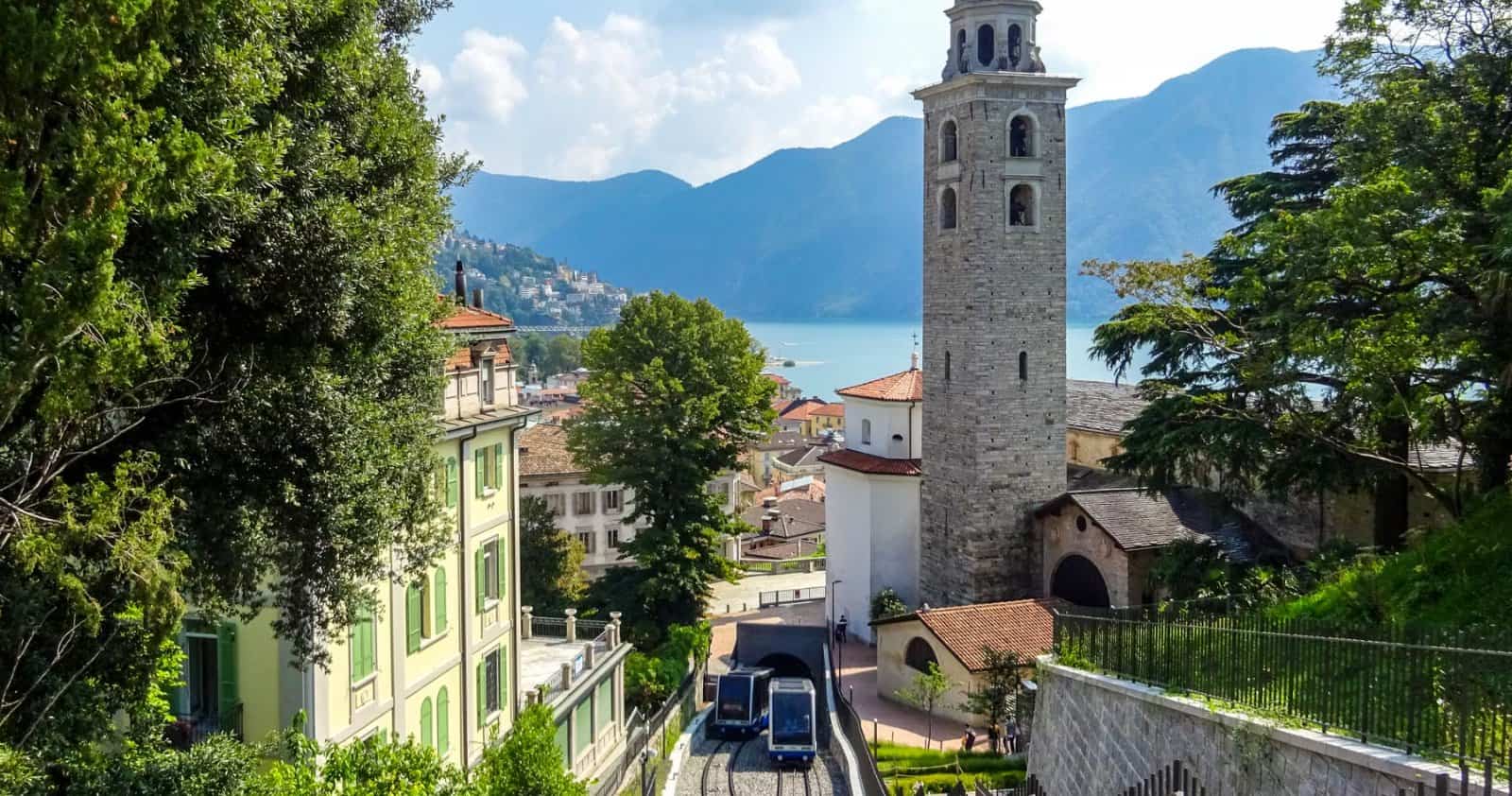
Ticino occupies the southern slope of the Alps, wedged into Italy on three sides, with Lugano and Locarno on the lakes and Bellinzona as capital. It is the only canton where Italian is the sole official language; politics are stable and consensus-driven, and taxation is radically decentralised — each of its roughly 100 communes sets its own multiplier. Switzerland is outside the EU but inside Schengen, with free movement of persons; the legal system is civil law and the courts are efficient. Milan is under an hour by train, Zurich about two. The climate is the mildest in Switzerland — palms, lake swimming, long sun hours. Costs are Swiss-high, and Ticino has the country’s most expensive compulsory health insurance: the 2026 average monthly premium is CHF 501.50 (~$617) across all ages and CHF 582.60 (~$717) for adults, up 7.1% on 2025.
This Ticino tax guide matters because the canton has quietly become one of Switzerland’s more competitive corporate locations while keeping the lifestyle draw of a Mediterranean lakefront inside a AAA-rated jurisdiction. The headline features are the 5.5% cantonal profit tax, no tax on private capital gains, no inheritance or gift tax within the direct family line, expenditure-based taxation for non-working foreign residents, and a 90% patent box. The counterweights are a real annual wealth tax and personal rates that remain mid-table nationally — though the reform approved by referendum on 9 June 2024, retroactive to 1 January 2024, cuts the top cantonal bracket in yearly steps: 14.5% in 2025, 14% in 2026, 13.5% in 2027, 13% in 2028, 12.5% in 2029 and 12% from 2030.
Direct Taxes
Swiss residents are taxed on worldwide income and wealth, with foreign real estate and permanent establishments exempted by treaty but still counted to set the rate. Tax is levied three times: federal direct tax at uniform national rates, cantonal tax, and communal tax. The cantonal and communal layers both work off the same cantonal base tax produced by the Ticino scale — the canton charges 100% of it, and each commune adds its own multiplier. That multiplier is the biggest single lever on your bill: official 2026 coordinated multipliers run from 56% in Porza and 58% in Paradiso to 100% in several valley communes, with Lugano at 81%, Mendrisio 78%, Chiasso 88%, Locarno 91% and Bellinzona 93%. Companies are resident if their seat or effective management is in Ticino. The signature regime for internationally mobile individuals is imposizione secondo il dispendio — expenditure-based taxation — covered under Strategy below.
Personal income tax (2026 bands — cantonal base tax, single taxpayers)
| Taxable income (CHF / USD) | Marginal rate on the slice | Effective rate at top of band |
|---|---|---|
| up to 12,500 (~$15,400) | 0.160% | 0.160% |
| 12,600–17,400 (~$15,500–21,400) | 5.232% | 1.588% |
| 17,500–20,800 (~$21,500–25,600) | 5.949% | 2.301% |
| 20,900–26,000 (~$25,700–32,000) | 3.923% | 2.625% |
| 26,100–30,100 (~$32,100–37,000) | 7.499% | 3.289% |
| 30,200–39,900 (~$37,100–49,100) | 9.461% | 4.805% |
| 40,000–52,700 (~$49,200–64,800) | 10.377% | 6.158% |
| 52,800–58,100 (~$65,000–71,500) | 10.988% | 6.607% |
| 58,200–73,000 (~$71,600–89,800) | 11.800% | 7.667% |
| 73,100–91,400 (~$89,900–112,400) | 11.597% | 8.458% |
| 91,500–113,900 (~$112,500–140,100) | 12.470% | 9.250% |
| 114,000–227,800 (~$140,200–280,200) | 13.080% | 11.165% |
| 227,900–380,600 (~$280,300–468,100) | 14.040% | 12.319% |
| 380,700 and above (~$468,300+) | 14.000% (2026) | — |
These are the 2025-indexed brackets of art. 35 LT; the 14% top rate is the 2026 transitional figure under art. 309g LT, replacing 14.5% in 2025 and the pre-reform 15.076%. Income below CHF 12,500 (~$15,400) is exempt for single filers and CHF 20,400 (~$25,100) for married couples and single parents, who use a separate, flatter scale topping out above CHF 761,500 (~$936,600). Federal direct tax sits on top, capped at 11.5%, which bites above roughly CHF 794,100 (~$977,000) single and CHF 941,500 (~$1,158,000) married in 2026. Net result for 2026: a top combined marginal rate of about 36.7% in Lugano, 38.5% in Bellinzona and roughly 33% in the cheapest communes, falling about two points by 2030.
Corporate income tax
| Item | Rate |
|---|---|
| Cantonal base profit tax (from 1 Jan 2025) | 5.5% of net profit |
| Cantonal base profit tax (2020–2024) | 8% |
| Federal direct tax on profit | 8.5% of post-tax profit (~7.83% effective) |
| Combined effective rate, Lugano (2026) | ~15.7% |
| Combined effective rate, Bellinzona / lowest communes | ~16.1% / ~14.6% |
| Patent box — reduction of qualifying net patent income | up to 90% |
| Cantonal capital tax | 1.5‰ of taxable equity |
| Capital tax, certified innovative companies (5 years) | 0.01‰ |
| Minimum tax (new from 2026) | CHF 450 (~$550); CHF 300 (~$370) for foundations |
| Associations and foundations | 4% (profit under CHF 5,000 / ~$6,150 exempt) |
Ticino cut the cantonal rate from 9% to 8% for 2020–2024 and then to 5.5% from 1 January 2025, implementing the federal TRAF/RFFA reform. Effective rates are computed on pre-tax profit because Swiss taxes are themselves deductible. The federal participation exemption removes most dividend and participation-gain income at group level, losses carry forward seven years, total patent-box and R&D relief is capped at 70% of taxable profit, and 16% of the profit tax is credited against the capital tax. Pillar Two applies to groups with consolidated revenue of €750 million or more (roughly $850–900 million at 2026 rates): Switzerland’s domestic top-up tax has applied since 1 January 2024 and the income inclusion rule since 1 January 2025, while the UTPR is suspended. For those groups the 15% floor now sits above Ticino’s headline rate — which is exactly why the canton redirected its reform towards personal income tax.
Social security and health contributions
| Contribution | Employee | Employer | Self-employed |
|---|---|---|---|
| AVS/AI/IPG (old age, disability, loss of earnings) | 5.3% | 5.3% | up to 10.0% (sliding scale) |
| Unemployment (AD/ALV) | 1.1% | 1.1% | not insured |
| Occupational pension (LPP, 2nd pillar) | per plan | at least 50% of total | voluntary |
| Accident insurance (LAINF) | non-occupational | occupational | voluntary |
| Family allowances (AF) | — | cantonal rate, employer only | own rate |
AVS/AI/IPG has no earnings ceiling, so it behaves like a flat 10.6% payroll tax at every income level; unemployment contributions stop at CHF 148,200 (~$182,300) of salary and the former solidarity surcharge above that ceiling has been abolished. Health insurance is not payroll-funded: every resident buys a compulsory private policy, and Ticino’s are the priciest in Switzerland at CHF 582.60 (~$717) a month for an average adult in 2026. Budget for it separately — for a family of four it is a material line, deductible only up to a capped lump sum.
Indirect Taxes
Switzerland sits outside the EU VAT area and runs its own federal VAT at the lowest standard rate in Europe. It is the main indirect tax; cantons and communes levy no VAT, so the rates below apply identically in Ticino.
Value-added tax (VAT)
| Rate | Applies to (examples) |
|---|---|
| 8.1% (standard) | Most goods and services |
| 3.8% (special) | Hotel and holiday accommodation, including breakfast |
| 2.6% (reduced) | Food, non-alcoholic drinks, books, newspapers, medicines |
| 0% (zero) | Exports, international transport, services supplied abroad |
Registration is compulsory above CHF 100,000 (~$123,000) of worldwide taxable turnover, with voluntary registration below it. These rates took effect on 1 January 2024, when the standard rate rose from 7.7% to 8.1% to part-fund the AVS.
Excise and other indirect taxes
| Tax | Notes |
|---|---|
| Federal excise duties | Tobacco, alcohol, beer, mineral oil and fuels, motor vehicles |
| Cantonal stamp duty (imposta di bollo) | 3‰ of contract value on notarial deeds, official assessed value as floor |
| Land registry and notarial fees | Charged on transfer, on top of the stamp duty |
| Federal securities transfer stamp tax | 1.5‰ Swiss / 3‰ foreign securities, where a Swiss dealer is involved |
| Motor vehicle tax | Cantonal, by weight and emissions |
Ticino levies no percentage-based property transfer tax of the kind used in most other cantons: a buyer’s transaction costs are the 3‰ stamp duty plus registry and notarial fees, which is unusually light by Swiss standards.
Other Taxes Worth Knowing
| Tax | Ticino treatment |
|---|---|
| Capital gains — private movable assets | None — tax-free for private investors (shares, bonds, funds, crypto) |
| Capital gains — professional traders | Taxed as ordinary income, plus AVS on the gain |
| Real-estate gains (TUI) | 31% if held ≤1 year, sliding to 4% if held >30 years |
| Dividends — resident individual, stake ≥10% | Only 70% taxable, federal and cantonal |
| Dividends — resident individual, stake <10% | 100% taxable at ordinary rates |
| Anticipatory (withholding) tax | 35% federal, fully refundable to declared Swiss residents |
| Interest | Ordinary income; 35% anticipatory tax, refundable |
| Rental income | Taxable; imputed rental value on your own home at 60–70% of market rent |
| Wealth / net worth tax | Yes — cantonal base 1.0‰–3.0‰, then cantonal and communal multipliers |
| Inheritance / estate tax | None for spouse, descendants and ascendants, including adoptive |
| Inheritance / gift tax — others | 15.5% (siblings, stepchildren, cohabiting partners) · 18.5% (nephews/nieces) · 27% (cousins, uncles/aunts) · 35% (unrelated), from 1 Jan 2024 |
| Gift / inheritance allowance | CHF 10,000 (~$12,300) net per year per beneficiary |
| Annual immovable property tax | None for individuals; legal persons pay 3‰ (2‰ plus a 1‰ surcharge for 2025–2027) of assessed value |
| Church tax | Opt-out; a percentage of ordinary cantonal tax set annually by each parish |
The wealth tax is what newcomers underestimate. Net wealth below CHF 200,000 (~$246,000) is exempt; above that the cantonal base runs at 1.0‰ to CHF 200,000, 2.0‰ to CHF 280,000 (~$344,000), 2.5‰ to CHF 700,000 (~$861,000), 3.0‰ to CHF 1,380,000 (~$1,698,000) and 2.5‰ thereafter — then multiplied by the cantonal and communal coefficients, so a Lugano resident pays about 4.5‰ at the margin. Married couples deduct CHF 60,000 (~$73,800), plus CHF 30,000 (~$36,900) per minor child. A statutory brake caps combined cantonal and communal income and wealth tax at 60% of total taxable income, with net investment income deemed to be at least 1% of net wealth. For an investor living off a diversified portfolio in Lugano, the practical outcome is that dividends and interest are taxed as income, the underlying gains are not taxed at all, and wealth tax works out as a soft annual charge of roughly 0.33–0.45% of assets.
Disadvantages & Risks
Ticino is a small, exposed economy — around 350,000 residents and a labour market coupled to Italy through nearly 79,000 cross-border commuters, which makes wage pressure a permanent political flashpoint and guarantees recurring initiatives on cross-border workers, foreign ownership and housing. It is also a high-cost place to live: the priciest health insurance in Switzerland, lakefront property to match, and a strong franc that inflates every local cost in dollar terms. Its financial sector, once built on undeclared Italian money, was hollowed out by Italy’s voluntary-disclosure programmes and the end of banking secrecy; the reputational legacy still surfaces in Italian audits of people who relocate. Italy is aggressive on residence disputes, and a move from Italy to Ticino draws scrutiny — the exit has to be clean and documented.
The tax advantage is also narrower than the headline rates suggest. Switzerland is not on the EU list of non-cooperative jurisdictions and not on the FATF grey list, and it applies full automatic exchange of information: this is a transparent jurisdiction, not an opaque one. Personal income tax stays mid-table nationally even after the reform, and Zug, Schwyz, Nidwalden and Obwalden are all materially cheaper — the case for Ticino is lifestyle, language and Milan, not the lowest Swiss rate. Pillar Two has already erased the corporate edge for large groups. The wealth tax is a genuine annual cost most competing jurisdictions do not levy. Lex Koller restricts residential purchases by non-resident foreigners and caps holiday-home permits by commune. And multipliers move: Lugano raised its 2026 multiplier by three points, so today’s low-multiplier calculation is not guaranteed.
Strategy & Ideal Profile
Two structures do the work: a Ticino holding or operating company, and expenditure-based taxation for an individual. A Swiss company holding subsidiaries gets the participation exemption on qualifying dividends and participation gains, a wide treaty network, the 5.5% cantonal rate, a capital tax reduced in proportion to qualifying participations, and a 90% patent-box deduction — with total relief capped at 70% of taxable profit. Certified innovative companies pay 0.01‰ capital tax and skip the minimum tax for five years; investors backing them can have income equal to their investment taxed separately at 1%, subject to a CHF 50,000 (~$61,500) minimum and a CHF 800,000 (~$984,000) annual cap. On the personal side, imposizione secondo il dispendio is open to foreign nationals taking up Swiss residence for the first time — or after ten years away — who carry on no gainful activity in Switzerland. Tax is assessed on deemed living expenditure at ordinary tariffs, subject to a floor that is the highest of CHF 434,700 (~$535,000), seven times annual rent or rental value, or three times annual board and lodging. A wealth-tax substitute applies on five times that base — minimum deemed wealth of CHF 2,173,500 (~$2,673,000) — and a control calculation stops the bill falling below ordinary tax on Swiss-source gross income and assets. On the statutory minimum, cantonal and communal income tax alone runs to roughly CHF 98,000 (~$120,600) a year in Lugano at its 2026 multiplier, before federal tax and the wealth substitute.
Who it suits: company owners holding at least 10% of their company, who draw profits as dividends taxable on only 70% of the amount and eventually sell the shares free of capital gains tax. Investors and traders running their own private portfolios, since realised gains on securities and crypto are untaxed as long as the activity stays private rather than professional. Wealthy non-working newcomers — retirees, family-office principals, people between ventures — who fit the lump-sum regime and value being 50 minutes from Milan Malpensa. And Italian-speaking entrepreneurs who want Swiss legal and monetary stability without giving up the language. Tax residence follows domicile, or a stay of 30 days with gainful activity (90 without), and you must actually live there — this is not a flag-planting jurisdiction.
Who it does not suit: anyone asset-rich and income-poor, because the wealth tax bites the balance sheet rather than the cash flow; active traders whose dealing is frequent or leveraged enough to be reclassified as professional; anyone needing a sub-15% effective corporate rate inside a group above the €750 million revenue threshold; and non-EU citizens without an employment or investment route, since permits outside the EU/EFTA framework are quota-limited and discretionary. Note also that the headline personal rate cut is staged — 12% does not arrive until 2030, and each annual step is a separate transitional provision a future Grand Council could revisit.
FAQ
Is Ticino a tax haven?
No. It is a Swiss canton inside a fully transparent jurisdiction: Switzerland applies automatic exchange of information and appears on neither the EU list of non-cooperative jurisdictions nor the FATF grey list. Ticino levies a genuine annual wealth tax and personal income tax reaching about 36.7% combined in Lugano in 2026. What it offers is a low corporate rate, no tax on private capital gains and a negotiated lump-sum regime — competitive, but far from zero-tax.
What is the corporate tax rate in Ticino in 2026?
The cantonal base rate is 5.5% of net profit, in force since 1 January 2025 (8% from 2020 to 2024). Adding the 100% cantonal coefficient, the communal multiplier and the 8.5% federal tax, the combined effective rate on pre-tax profit is about 15.7% in Lugano, around 16.1% in Bellinzona and about 14.6% in the lowest-multiplier communes.
How does lump-sum taxation work in Ticino?
Foreign nationals taking up Swiss residence for the first time — or after ten years abroad — and not working in Switzerland can be taxed on deemed annual living expenditure instead of actual income. The base is the highest of CHF 434,700 (~$535,000), seven times rent or rental value, or three times board and lodging, taxed at ordinary Ticino and federal tariffs, plus a wealth-tax substitute on five times that base. The figure is agreed with the cantonal tax administration before you move.
What is the communal multiplier and why does it matter?
Ticino’s scale produces a “base tax”. The canton charges 100% of it and your commune adds its own multiplier on top. Official 2026 coordinated multipliers range from 56% in Porza to 100% in several valley communes, with Lugano at 81% and Bellinzona at 93%. Picking a low-multiplier commune can cut three to four percentage points off your effective rate — the single largest planning decision in the canton.
Does Ticino tax capital gains?
Not on private movable assets: gains on shares, bonds, funds and crypto held privately are tax-free. Two carve-outs matter — gains reclassified as professional trading are taxed as income and attract social contributions, and gains on Ticino real estate face a separate cantonal tax of 31% if sold within a year, sliding to 4% after 30 years of ownership.
Is there inheritance or wealth tax in Ticino?
There is no inheritance or gift tax between spouses, direct descendants or direct ascendants, including adoptive relationships. Other beneficiaries pay 15.5% to 35% by degree of relationship, above a CHF 10,000 (~$12,300) annual allowance. Wealth tax does exist: net wealth above CHF 200,000 (~$246,000) is taxed at a cantonal base of 1.0‰ to 3.0‰, then multiplied by the cantonal and communal coefficients.
How are dividends taxed for a Ticino resident shareholder?
Hold at least 10% of the company and only 70% of the dividend is taxable, federally and cantonally — the remaining 30% is exempt to offset corporate tax already paid. Below 10%, the dividend is fully taxable at ordinary rates. Swiss-source dividends suffer 35% anticipatory tax at source, refunded in full once the income is declared on your Swiss return.
Sources
All figures should be checked against the primary government sources below. Only official government bodies are listed here.
- Divisione delle contribuzioni, Repubblica e Cantone Ticino — cantonal income, wealth, corporate, inheritance, gift and real-estate gains taxes — ti.ch
- Raccolta delle leggi del Cantone Ticino — Legge tributaria (RL 640.100), arts. 13, 35, 49, 49a, 76, 87, 95–98, 309g–309h — ti.ch
- Amministrazione federale delle contribuzioni (AFC) — federal direct tax tariffs, VAT rates, anticipatory tax and the official Ticino cantonal tax sheet — estv.admin.ch
- Dipartimento federale delle finanze (DFF) — expenditure-based (lump-sum) taxation — efd.admin.ch
- Sezione degli enti locali, Cantone Ticino — coordinated communal tax multipliers 2026 — ti.ch
- Centro d’informazione AVS/AI — AVS/AI/IPG and unemployment contribution rates and ceilings — ahv-iv.ch
- Ufficio federale della sanità pubblica (UFSP) — 2026 compulsory health insurance premiums by canton — bag.admin.ch
- Ufficio federale di statistica (UST) — resident population and cross-border worker statistics — bfs.admin.ch
- Banca nazionale svizzera (BNS) — exchange rate used for USD conversions — snb.ch
USD figures are indicative conversions at ~1 CHF = 1.23 USD (Swiss National Bank reference rate, 1 USD = 0.8128 CHF, 13 August 2026) and rounded.
Last verified: 15 August 2026.
This is general information, not personal tax or legal advice. Tax outcomes depend on your specific facts; consult a qualified Swiss or Ticino tax adviser before acting.
Related guides: Andorra · Argentina · Australia · Bahamas · Botswana · Brunei · Bulgaria · Ceuta and Melilla · Chile · China · Costa Rica · Cyprus · Denmark · Dominican Republic · El Salvador · Estonia · Florida · Georgia · Gibraltar · Greece · Hawaii · Hong Kong · Iceland · Indonesia · Isle of Man · Italy · Jersey · Kuwait · Latvia · Macau · Malta · Mauritius · Monaco · Montenegro · Morocco · New Zealand · Panama · Paraguay · Philippines · Portugal · Puerto Rico · Romania · Sark · Seychelles · Singapore · South Korea · Taiwan · Thailand · UAE · Uruguay · Zug