This Seychelles tax guide covers the rules in force from 1 January 2026. The system is strictly territorial — only Seychelles-source income is taxed, so residents pay 0% on foreign income, gains and pensions. Local business profits bear 15% up to SCR 1 million (~$69,000) and 25% above; employment income runs through modest monthly bands to 30%; and there is no capital gains, inheritance or wealth tax. In February 2026 the EU removed Seychelles from its tax grey list, closing a three-year listing saga.
Introduction
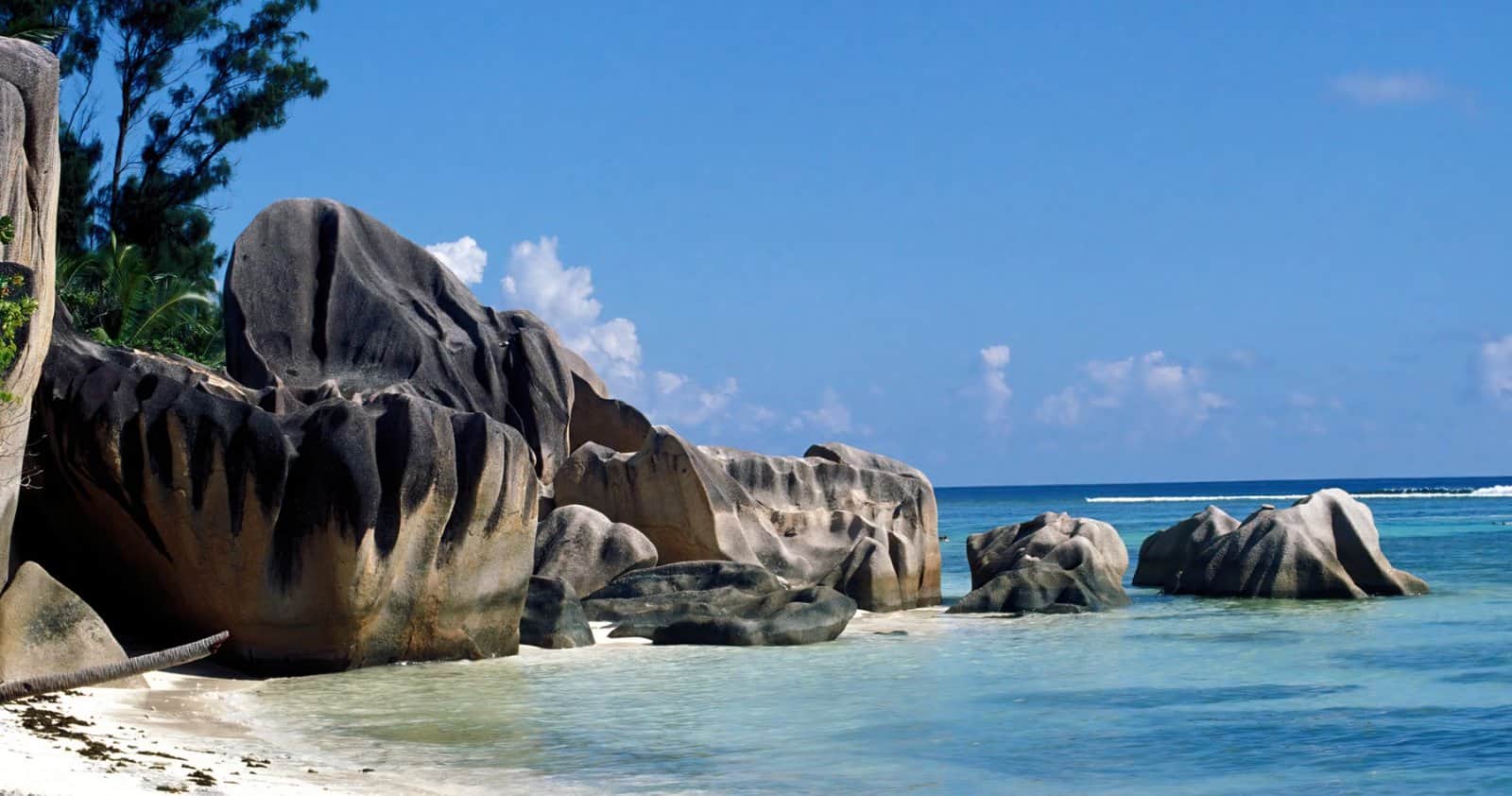
Seychelles is an archipelago of 115 granite and coral islands scattered across the western Indian Ocean, 1,600 km east of Kenya — Africa’s smallest country by population (~100,000) and its richest per capita. A multi-party democracy since 1993 with peaceful transfers of power, it is a member of the Commonwealth, African Union, COMESA and SADC. Creole, English and French are official languages; the legal system mixes English common law and French civil code; the climate is equable year-round outside the cyclone belt; and life centres on Mahé, Praslin and La Digue. Costs are high for an island state — most goods are imported — but property and services undercut comparable tropical havens.
For internationally-mobile investors, this Seychelles tax guide matters because territoriality here is total and simple: no tax on foreign income for individuals or (with substance conditions) companies, no capital gains tax at all, no death duties, and an offshore sector — roughly 200,000 registered IBCs — that survived the post-BEPS cleanup by moving onshore-lite rather than disappearing. The reputational arc is the recent story: blacklisted by the EU in October 2023 over information-exchange grading, moved to the grey list in February 2024, and removed entirely in February 2026 after a positive Global Forum reassessment.
Direct Taxes
Seychelles taxes on a source basis — the key concept for investors. Individuals pay income tax only on Seychelles-source employment and business income; foreign salaries, dividends, gains and pensions are simply outside the system, resident or not. Progressivity is mild, through monthly PAYE bands to 30%. Companies (including IBCs) are assessable on Seychelles-source income under the Business Tax Act; foreign-source income is exempt, with passive-income streams of covered companies conditioned on economic substance — the framework built to satisfy the EU and OECD.
Personal income tax (2026 monthly bands)
| Monthly income (SCR) | Rate |
|---|---|
| 0 – 8,555.50 (~$0 – 590) — citizens only | 0% |
| 8,555.51 – 10,000 (~$590 – 690) | 15% |
| 10,000.01 – 83,333 (~$690 – 5,700) | 20% |
| Over 83,333 (~$5,700) | 30% |
| Non-Seychellois employees — no 0% band; 15% from the first rupee to SCR 10,000, then as above | 15/20/30% |
| All foreign-source income (any resident) | 0% — outside the tax base |
These bands date from the 2018 progressive income tax reform (which replaced a 15% flat tax); the citizen-only exempt threshold is the one nationality-based wrinkle. Non-monetary benefits are taxed to the employer at 20% separately. There is no joint filing, no municipal income tax, and — because the base is territorial — no foreign-income reporting at all.
Corporate income tax (business tax)
| Item | Rate |
|---|---|
| Business tax — first SCR 1,000,000 (~$69,000) of taxable income (from 1 Jan 2022) | 15% |
| Business tax — above SCR 1,000,000 | 25% |
| Prior standard rates (to 2021) | 25% / 33% |
| Telecoms, banks, insurers, alcohol & tobacco producers | 25% / 33% |
| Foreign-source income (incl. IBCs), with substance conditions on passive streams | Exempt |
| Withholding — dividends, interest, royalties to non-residents | 15% |
The 15/25% scale (cut from 25/33% with effect from 2022) applies to entities doing business in Seychelles. IBCs pay nothing unless they derive Seychelles-source income; foreign passive income (dividends, interest, IP) of covered companies stays exempt only where the Economic Substance and related 2021 amendments are met — the concession that kept the offshore registry alive through EU scrutiny. Dividends paid out of taxed profits to resident shareholders carry no further tax. Losses carry forward five years. Seychelles is far below Pillar Two’s €750m (~$855m) radar for domestic purposes and has ~28 tax treaties, including China, India, UAE and much of Africa.
Social security and health contributions
| Contribution | Employee | Employer | Self-employed |
|---|---|---|---|
| Seychelles Pension Fund (SPF) | 3% | 3% | Voluntary (minimum SCR contribution) |
There is no general social security tax — the old contribution was folded into income tax years ago — so the entire payroll add-on is the 3%+3% pension charge (confirm current SPF floors/ceilings). Healthcare is tax-funded and free at point of use for citizens; expatriates carry private cover. No scheduled rises are legislated.
Indirect Taxes
VAT is the main indirect tax — a standard credit-invoice model introduced in 2013, administered by the Seychelles Revenue Commission, with compulsory registration above SCR 2 million (~$138,000) turnover (confirm threshold).
Value-added tax (VAT)
| Rate | Applies to (examples) |
|---|---|
| 15% (standard) | Most goods and services, including imports at the border |
| 0% (zero) | Exports of goods and services, international transport |
| Exempt | Basic foodstuffs, education, health, financial services, residential rent |
Excise and other indirect taxes
| Tax | Notes |
|---|---|
| Excise duties | Alcohol, tobacco, fuel, motor vehicles — steep on vehicles |
| Tourism marketing tax / environmental levies | Sector levies incl. SCR 25/night visitor environmental levy |
| Stamp duty — property transfers | 5% of value |
| Non-Seychellois property sanction | Government approval plus additional duty on foreign purchases |
| Customs duties | Broadly low post-WTO accession (2015); revenue shifted to VAT/excise |
Other Taxes Worth Knowing
| Tax | Seychelles treatment |
|---|---|
| Capital gains tax | None — no CGT on shares, property, crypto or anything else |
| Dividends (resident individual, Seychelles company) | No further tax on distributions from taxed profits |
| Dividends/interest (foreign source) | 0% — outside the territorial base |
| Interest (resident individual, local banks) | Final withholding 15% (confirm scope) |
| Rental income (Seychelles property) | Business tax rates; non-residents 15% withholding |
| Wealth / net worth tax | None |
| Inheritance / estate tax | None |
| Gift tax | None (stamp duty applies to property transfers) |
| Immovable property tax (annual) | 0.25% of market value — non-Seychellois owners only (since 1 Jan 2020); citizens: none |
| Exit tax | None |
The consolidated picture is one of the cleanest anywhere: a resident foreigner with offshore wealth owes Seychelles nothing on it — no tax, no filing — and locally only PAYE on any Seychelles salary, 15% VAT on spending, and 0.25% a year on a Seychelles home. The territorial base means even remitting foreign income onshore triggers nothing, a step simpler than the remittance-basis systems of Malta, Mauritius or Thailand.
Disadvantages & Risks
Reputation is the first theme. The IBC legacy — decades as a bulk incorporation mill — still colours perception: correspondent banks treat Seychelles structures warily, account opening is slow and document-heavy, and the domestic banking sector is thin (a handful of banks, modest correspondent networks). The EU listing history — blacklisted October 2023, grey-listed February 2024, cleared February 2026 — shows both the vulnerability and the willingness to reform; Seychelles is now on no EU or FATF list, but the cycle could repeat if Global Forum grades slip again. Substance requirements are real for companies claiming foreign-passive-income exemptions, and nominee-heavy legacy structures are exactly what audits target.
The structural constraints are those of a micro-economy: ~100,000 people, output concentrated in tourism and tuna, import dependence that transmits global prices straight into living costs, and exposure to climate events and Indian Ocean geopolitics. The rupee floats and has swung hard in crises (2008 devaluation, 2020 tourism collapse — SCR briefly lost a third of its value). Skilled labour is scarce, flights are expensive, and the property market for foreigners is deliberately gated by sanction requirements and the 0.25% annual tax. None of these erode the tax position — which has, if anything, strengthened post-cleanup — but they cap how much economic life one can practically run from the islands.
Strategy & Ideal Profile
The structures are refreshingly simple. Individuals just become resident — no election, no minimum tax, no regime paperwork — and hold wealth offshore, where the territorial base ignores it. Companies split cleanly: an IBC for international activity (0% on foreign income, ~US$100–150 annual government fee, substance rules for passive streams) and, if trading locally, a domestic entity at 15/25%. Dividends from taxed local profits reach resident owners with no second layer, and non-resident owners at 15% withholding, treaty-reducible. Property investors accept the 5% stamp duty, sanction process and 0.25% annual foreign-owner tax as the full recurring cost — with zero CGT on eventual sale.
Who it suits: investors and traders with offshore portfolios — no tax, no reporting, no remittance traps, ever; retirees whose pensions and investment income are foreign-source and therefore untouched; company owners running international operations through IBCs with genuine substance where needed; and location-independent entrepreneurs who want a lawful 0% on foreign earnings inside a functioning democracy with direct flights to the Gulf, Europe and Africa. Residence is permit-based rather than tax-tested: gainful occupation permits for workers and the self-employed, residence permits for investors (substantial discretionary investment, commonly cited around US$1m — confirm current criteria), with tax territoriality applying regardless.
Who it does not suit: anyone whose income is Seychelles-source — local salaries hit 30% quickly and foreign employees lose the exempt band; businesses needing deep banking or cheap credit; structures without substance hoping to warehouse passive income invisibly — that era ended with the 2021 amendments; and families needing big-city schooling, healthcare depth or labour pools. The 0% on foreign income has no sunset — it is the architecture, not an incentive — but the EU-list cycle shows the compliance perimeter around it will keep being renegotiated.
FAQ
Is Seychelles a tax haven?
It is a territorial-tax jurisdiction with a large offshore registry, but a reformed one: economic-substance rules, beneficial-ownership registers, CRS exchange, and — as of February 2026 — no presence on any EU or FATF list. Domestic taxes (15% VAT, 15–25% business tax, PAYE to 30%) are real; only foreign-source income sits at 0%.
What is the corporate tax rate in Seychelles in 2026?
15% on the first SCR 1 million (~$69,000) of taxable income and 25% above, for Seychelles-source profits (banks, telecoms, insurers and alcohol/tobacco producers pay 25/33%). Foreign-source income is exempt under the territorial system, subject to substance conditions on passive income. IBCs with no local income pay no business tax.
How does territorial taxation work in Seychelles?
Only income sourced in Seychelles is taxable. Foreign salaries, business profits, dividends, interest, capital gains and pensions are outside the tax base for individuals entirely — whether or not remitted to Seychelles. Companies get the same treatment, with economic-substance requirements attached to foreign passive income of covered entities.
Does Seychelles tax capital gains?
No. There is no capital gains tax for individuals or companies, on any asset class, local or foreign. Property sales bear the 5% stamp duty as a transaction cost, but appreciation itself is untaxed.
Is there inheritance or wealth tax in Seychelles?
No. Seychelles levies no inheritance, estate or gift tax and no wealth tax. The only recurring ownership charge is the 0.25% annual immovable-property tax on non-Seychellois owners of Seychelles real estate, introduced in 2020.
How are dividends taxed for a resident investor in Seychelles?
Dividends from Seychelles companies paid out of taxed profits carry no further tax for residents. Foreign dividends are outside the territorial base — 0%, with nothing to file. Non-residents receiving Seychelles dividends face a 15% withholding, reduced under the ~28 tax treaties.
Was Seychelles removed from the EU tax lists?
Yes. Seychelles was placed on the EU blacklist (Annex I) in October 2023 over an information-exchange grading, moved to the grey list (Annex II) in February 2024 pending a supplementary Global Forum review, and removed altogether in February 2026 after the positive reassessment.
Sources
All figures should be checked against the primary government sources below.
- Seychelles Revenue Commission (SRC) — income tax bands, business tax, VAT, withholding — src.gov.sc
- Ministry of Finance, National Planning and Trade — tax policy statements and reform laws — finance.gov.sc
- Seychelles Pension Fund — SPF contribution rates — pensionfund.sc
- Financial Services Authority (FSA) Seychelles — IBC framework and substance requirements — fsaseychelles.sc
- Council of the EU — EU list of non-cooperative jurisdictions (Seychelles delisting) — consilium.europa.eu
- Central Bank of Seychelles — SCR/USD reference rates used for conversions — cbs.sc
USD figures are indicative conversions at ~1 USD = 14.5 SCR (Central Bank of Seychelles reference, mid-July 2026) and rounded.
Last verified: 18 July 2026.
This is general information, not personal tax or legal advice. Tax outcomes depend on your specific facts; consult a qualified Seychelles tax adviser before acting.
Related guides: Andorra · Argentina · Australia · Bahamas · Botswana · Brunei · Bulgaria · Ceuta and Melilla · Chile · China · Costa Rica · Cyprus · Denmark · Dominican Republic · El Salvador · Estonia · Florida · Georgia · Gibraltar · Greece · Hawaii · Hong Kong · Iceland · Indonesia · Isle of Man · Italy · Jersey · Kuwait · Latvia · Macau · Malta · Mauritius · Monaco · Montenegro · Morocco · New Zealand · Panama · Paraguay · Philippines · Portugal · Puerto Rico · Romania · Sark · Singapore · South Korea · Taiwan · Thailand · Ticino · UAE · Uruguay · Zug