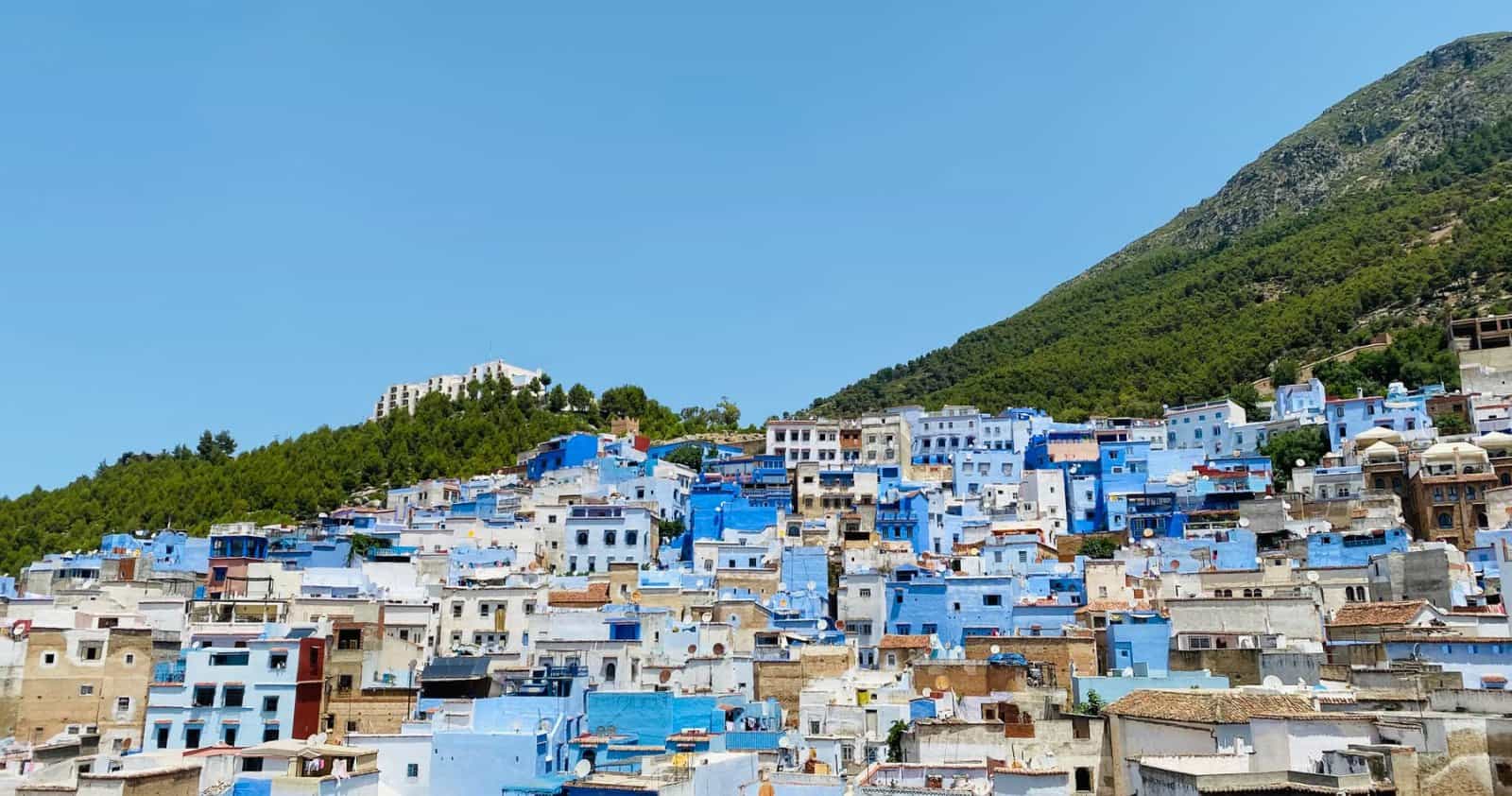
This Morocco tax guide covers the rules in force from 1 January 2026 — the year Morocco’s multi-year tax overhaul reaches its destination. Personal income tax now runs from 0% (below MAD 40,000 (~$4,300)) to a 37% top rate, corporate tax settles at 20%/35%, dividend withholding completes its fall from 15% to 10%, and VAT is simplified to two rates. There is no wealth tax, no inheritance tax in the direct line — and from 2026, basic retirement pensions are fully exempt from income tax.
Introduction
Morocco sits at the north-west corner of Africa, fifteen kilometres from Spain across the Strait of Gibraltar, with Atlantic and Mediterranean coastlines, the Atlas mountains and a stable constitutional monarchy that has made itself the West’s essential partner in the region. Arabic and Amazigh are official languages, but French is the language of business and law (a civil-law system with French roots), and English is spreading fast. The draw is practical: three-hour flights to Europe, a Mediterranean-to-desert climate, and a cost of living far below Western Europe — Casablanca is the commercial capital, while Rabat, Marrakech and Tangier anchor government, tourism and industry. Morocco is not in the EU but holds an EU Association Agreement, advanced-status trade ties, a US free-trade agreement and more than 50 double-tax treaties.
For internationally-mobile investors this Morocco tax guide matters because the country has just finished rebuilding its tax system. The 2023–2026 corporate tax convergence, the 2024–2026 VAT simplification and the 2025 income-tax cut have replaced a patchwork of derogatory regimes with a cleaner, moderately-taxed system — crowned by Casablanca Finance City (Africa’s leading financial hub), an 80% income-tax reduction on repatriated foreign pensions, and, from 1 January 2026, a full exemption for basic retirement pensions. World Cup 2030 co-hosting is pulling in a decade of infrastructure investment.
Direct Taxes
Moroccan tax residents are taxed on worldwide income at progressive rates; non-residents pay tax only on Moroccan-source income, generally via flat withholding taxes. You are resident if your permanent home (foyer), centre of economic interests, or more than 183 days in any 365 are in Morocco. A company is resident if incorporated or effectively managed in Morocco. The signature concept for investors is the finished 2023–2026 convergence: one corporate scale (20%/35%), one dividend rate (10%), two VAT rates — the transitional rates that governed 2023–2025 are gone from 1 January 2026.
Personal income tax (2026 bands)
| Chargeable income (MAD, USD) | Rate |
|---|---|
| 0 – 40,000 (~$4,300) | 0% |
| 40,001 – 60,000 (~$4,300 – 6,400) | 10% |
| 60,001 – 80,000 (~$6,400 – 8,500) | 20% |
| 80,001 – 100,000 (~$8,500 – 10,600) | 30% |
| 100,001 – 180,000 (~$10,600 – 19,100) | 34% |
| Over 180,000 (over ~$19,100) | 37% |
These bands took effect on 1 January 2025 (Finance Law 2025), which raised the exempt threshold from MAD 30,000 (~$3,200) to MAD 40,000 (~$4,300), widened every bracket and cut the top rate from 38% to 37% — an effective cut of up to 50% for modest incomes. A family reduction of MAD 500 (~$53) per dependant applies, capped at MAD 3,000 (~$320) a year. Retirees do dramatically better: basic pensions and life annuities are 100% exempt from 1 January 2026 (after a 50% step in 2025), and foreign-source pensions transferred definitively into non-convertible dirhams enjoy an 80% reduction of the tax due — pushing effective rates on a typical foreign pension into the low single digits.
Corporate income tax
| Item | Rate |
|---|---|
| Standard corporate income tax (from 1 January 2026) | 20% |
| Large companies — net profit ≥ MAD 100m (~$10.6m) | 35% |
| Banks, insurance and credit institutions | 40% |
| Casablanca Finance City — first 5 years (export turnover) | 0% |
| Social solidarity contribution — profit ≥ MAD 1m (~$106,000), extended 2026–2028 | 1.5% – 5% |
2026 is the terminal year of the four-year convergence begun by Finance Law 2023: the old 10%/20%/31% scale and most special regimes are replaced by a flat 20%, with 35% reserved for profits of MAD 100 million (~$10.6m) and up and 40% for the financial sector. Casablanca Finance City entities keep a five-year corporate tax holiday on export turnover, then join the 20% rate; CFC employees may opt for a 20% flat income tax for 10 years. The social solidarity contribution — a surtax of 1.5%–5% on profits above MAD 1m (~$106,000) — has been extended through 2028 and also reaches individuals with business profits at that level. Losses carry forward four years (indefinitely for depreciation). Morocco has no Pillar Two legislation in force yet. Withholding taxes: dividends 10%, interest on non-resident loans 10%, royalties and technical fees to non-residents 10% — all before treaty relief.
Social security and health contributions
| Contribution | Employee | Employer | Self-employed |
|---|---|---|---|
| CNSS social branches (capped) | 4.48% | 8.98% | Simplified scheme (TNS) |
| AMO health insurance (uncapped) | 2.26% | 4.11% | AMO for self-employed |
| Family allowances + training tax (uncapped) | — | 6.40% + 1.60% | — |
| Total | 6.74% | 21.09% | varies |
The social branches (pensions, short-term benefits) are calculated on salary capped at MAD 6,000 (~$640) a month — a maximum employee deduction of about MAD 269 (~$29) monthly — while AMO health contributions, family allowances and the 1.6% training tax apply to the full uncapped salary. Total employer cost is therefore ~21% but with a modest absolute ceiling on the capped portion; for high salaries the real marginal burden is the ~12% of uncapped items. Morocco is progressively extending AMO and pension coverage to the self-employed under fixed-basis schemes.
Indirect Taxes
The main indirect tax is VAT (TVA), overhauled by the 2024 Finance Law: over 2024–2026 the old 7% and 14% intermediate rates were phased out, leaving a clean two-rate system (plus zero-rating) from 1 January 2026.
Value-added tax (VAT)
| Rate | Applies to (examples) |
|---|---|
| 20% (standard) | Most goods and services; electricity |
| 10% (reduced) | Water, gas, banking and credit services, hotel and restaurant services |
| 0% (zero) / exempt | Exports, basic staple foods (bread, flour, milk, sugar), agriculture, medicines |
Non-resident providers of digital services to Moroccan customers must register and charge Moroccan VAT. Refund mechanisms exist for exporters and investment goods, and a withholding mechanism applies on VAT invoiced by suppliers who fail tax-compliance checks.
Excise and other indirect taxes
| Tax | Notes |
|---|---|
| Domestic consumption taxes (TIC) | Fuel, tobacco, alcohol and sugary drinks — substantial and regularly increased |
| Customs duties | 0%–40% by product; largely eliminated on EU and US goods under free-trade agreements |
| Registration duties | 1%–6% on deeds: typically 4% on built property, 5% on land, plus 1.5% land-registry fee; MAD 200 (~$21) flat for select deeds |
| Stamp duties | Minor fixed and proportional duties on documents |
Other Taxes Worth Knowing
| Tax | Morocco treatment |
|---|---|
| Capital gains tax — securities | 15% on listed shares, 20% on unlisted shares and bonds (final withholding where paid through a Moroccan intermediary) |
| Capital gains tax — real estate | 20% of the gain, with a minimum tax of 3% of the sale price; main residence held 6+ years exempt |
| Dividends (resident individual) | 10% final withholding — down from 15% (2022) via 13.75%/12.5%/11.25% steps; profits earned before 2023 still distribute at 15% |
| Interest (resident individual) | 30% final withholding (20%, creditable, for business lenders with tax ID) |
| Rental income | Final withholding: 10% below MAD 120,000 (~$12,800) gross a year, 15% above; new 5% advance withholding by corporate tenants from 1 July 2026 |
| Wealth / net worth tax | None |
| Inheritance / estate tax | None — successions in the direct line (spouse, ascendants, descendants) are exempt from registration duties |
| Gift tax | Direct-line gifts: 1.5% registration duty and exempt from real-estate gains tax; unrelated parties pay standard duties |
| Immovable property tax (annual) | Taxe d’habitation on rental value (75% abatement for the main home) plus municipal services tax of 10.5% urban / 6.5% peripheral — modest in practice |
The striking feature is what’s missing: no wealth tax, no estate tax, and near-free intergenerational transfers in the direct line. A resident investor’s passive income is taxed at flat, final rates — 10% dividends, 15% listed gains, 10–15% rents — that undercut the 37% scale dramatically; the progressive bands effectively apply only to salaries, business profits and pensions (and pensions now barely at all). The real-estate minimum tax of 3% of price bites when gains are small — factor it into short holds.
Disadvantages & Risks
The binding constraint is the dirham itself: Morocco maintains exchange controls under the Office des Changes. The currency is only partially convertible, pegged to a 60% euro / 40% dollar basket inside a ±5% band; residents face limits on moving capital abroad, and becoming tax-resident can bring your global investment flows inside that perimeter. Foreign investors are protected only if they register their investment on entry — registration guarantees repatriation of capital and profits in foreign currency; skip it and getting money out becomes painful. Add a cash-heavy informal economy, uneven bureaucracy in land titling and permits, and courts that work in French and Arabic at a deliberate pace.
Macro and political risks are real but contained: the economy leans on agriculture (drought-prone), phosphates, tourism and remittances; unemployment among the young is high; and the unresolved Western Sahara question shapes diplomacy (relations with neighbouring Algeria are frozen and the land border closed). On the compliance front the news is good: Morocco exited the FATF grey list in February 2023 and sits on no EU tax blacklist, having reformed the old export and CFC incentives that once drew scrutiny. The flip side of that respectability is the loss of the sweetest legacy rates — the CFC’s old 8.75% is gone, the solidarity surtax keeps being renewed, and worldwide taxation with only a 4-year loss carry-forward leaves little room for aggressive structuring.
Strategy & Ideal Profile
The structures that work are simple and official. An operating or holding company at 20% (kept under MAD 100m (~$10.6m) profit) distributing at 10% withholding gives a combined burden of ~28% to the shareholder’s pocket — respectable, not spectacular. The step-change comes with Casablanca Finance City status for financial firms, regional headquarters, and professional-services groups serving Africa: 0% corporate tax for five years on export turnover, 20% thereafter, a 20% flat income tax for staff for 10 years, exchange-control facilities, and Africa’s best hub credentials. Individuals structure around the flat finals: dividends at 10%, listed gains at 15%, rentals at 10–15% — and retirees route pensions into Morocco for the 80% reduction, or rely on the 2026 full exemption of basic pensions.
Who it suits: retirees — with the 80% repatriation reduction or full basic-pension exemption plus low living costs, Morocco is now one of the most tax-friendly retirement bases on the Mediterranean rim; entrepreneurs serving Africa and Europe, for whom CFC status plus the treaty network turns Casablanca into a genuine regional platform; property investors, who enjoy 10–15% final tax on rents, a 6-year path to a tax-free main-residence sale, and duty-free direct-line succession; and dividend earners, taxed at a flat 10% (~$0 additional filing burden — withholding is final). Residency is straightforward: a residence permit, then 183 days or your economic centre of gravity makes you tax-resident; there is no minimum-investment golden-visa scheme to buy.
Who it does not suit: high-salary remote employees, who hit 37% at just MAD 180,000 (~$19,100) — among the lowest top-rate thresholds anywhere; traders and holders of large liquid portfolios, for whom exchange controls are a structural irritation; and anyone expecting a zero-tax haven — Morocco taxes worldwide income, has no non-dom regime, and its advantages are targeted (pensions, CFC, flat finals) rather than general. The pension exemptions and CFC terms are creatures of finance laws that change annually — model on current law, not on permanence.
FAQ
Is Morocco a tax haven?
No. Morocco taxes residents on worldwide income at up to 37%, applies 20%–40% corporate rates and sits on no EU or FATF list — it exited the FATF grey list in February 2023. Its appeal is targeted: 10% final tax on dividends, 15% on listed gains, an 80% reduction on repatriated foreign pensions, no wealth or direct-line inheritance taxes, and the Casablanca Finance City regime.
What is the corporate tax rate in Morocco in 2026?
20% as the standard rate, 35% for companies with net profit of MAD 100 million (~$10.6m) or more, and 40% for banks and insurers — the final rates of the 2023–2026 convergence, fully in force from 1 January 2026. A 1.5%–5% solidarity surtax applies above MAD 1 million (~$106,000) of profit through 2028.
How does the Casablanca Finance City regime work?
Companies granted CFC status by the CFC Authority pay 0% corporate tax on export (non-Moroccan) turnover for their first five years, then the standard 20%. Employees can elect a flat 20% income tax for up to ten years, and CFC entities enjoy relaxed exchange-control treatment. The regime was rewritten in 2020–2023 to satisfy EU and OECD standards, so substance in Casablanca is expected.
What is the 183-day rule in Morocco?
You are Moroccan tax-resident if you spend more than 183 days in Morocco within any 365-day period — or, regardless of days, if your permanent home or centre of economic interests is there. Residents are taxed on worldwide income; non-residents only on Moroccan-source income, mostly via flat withholdings.
Does Morocco tax capital gains?
Yes, at flat rates: 15% on listed shares, 20% on unlisted shares and bonds, and 20% on real-estate gains with a minimum tax of 3% of the sale price. A main residence held six years or more sells exempt, and direct-line gifts of property escape gains tax entirely.
Is there inheritance or wealth tax in Morocco?
No wealth tax exists, and there is no inheritance tax as such: successions to spouses, parents and children are exempt from registration duties, and direct-line lifetime gifts pay only a 1.5% registration duty. Note that Moroccan family law can govern succession mechanics for Muslim residents, so estate planning still needs local advice.
How are foreign pensions taxed in Morocco?
Foreign-source pensions transferred definitively into non-convertible dirhams benefit from an 80% reduction of the Moroccan tax due on the amount transferred — typically an effective rate in the low single digits. Separately, basic-scheme retirement pensions and life annuities are fully exempt from income tax from 1 January 2026 under Finance Law 2025.
Sources
All figures should be checked against the primary government sources below. Only official government bodies are listed here.
- Direction Générale des Impôts (DGI) — income tax, corporate tax, VAT, registration duties, General Tax Code — tax.gov.ma
- Caisse Nationale de Sécurité Sociale (CNSS) — social security and AMO contribution rates and ceilings — cnss.ma
- Ministry of Economy and Finance — Finance Laws 2023–2026, reform texts, Official Bulletin — finances.gov.ma
- Office des Changes — exchange-control rules, foreign-investment registration and repatriation — oc.gov.ma
- Bank Al-Maghrib — exchange rate used for USD conversions — bkam.ma
USD figures are indicative conversions at ~9.4 MAD = 1 USD (Bank Al-Maghrib reference rate, July 2026) and rounded.
Last verified: 26 July 2026.
This is general information, not personal tax or legal advice. Tax outcomes depend on your specific facts; consult a qualified Moroccan tax adviser before acting.
Related guides: Andorra · Argentina · Australia · Bahamas · Botswana · Brunei · Bulgaria · Ceuta and Melilla · Chile · China · Costa Rica · Cyprus · Denmark · Dominican Republic · El Salvador · Estonia · Florida · Georgia · Gibraltar · Greece · Hawaii · Hong Kong · Iceland · Indonesia · Isle of Man · Italy · Jersey · Kuwait · Latvia · Macau · Malta · Mauritius · Monaco · Montenegro · New Zealand · Panama · Paraguay · Philippines · Portugal · Puerto Rico · Romania · Sark · Seychelles · Singapore · South Korea · Taiwan · Thailand · Ticino · UAE · Uruguay · Zug