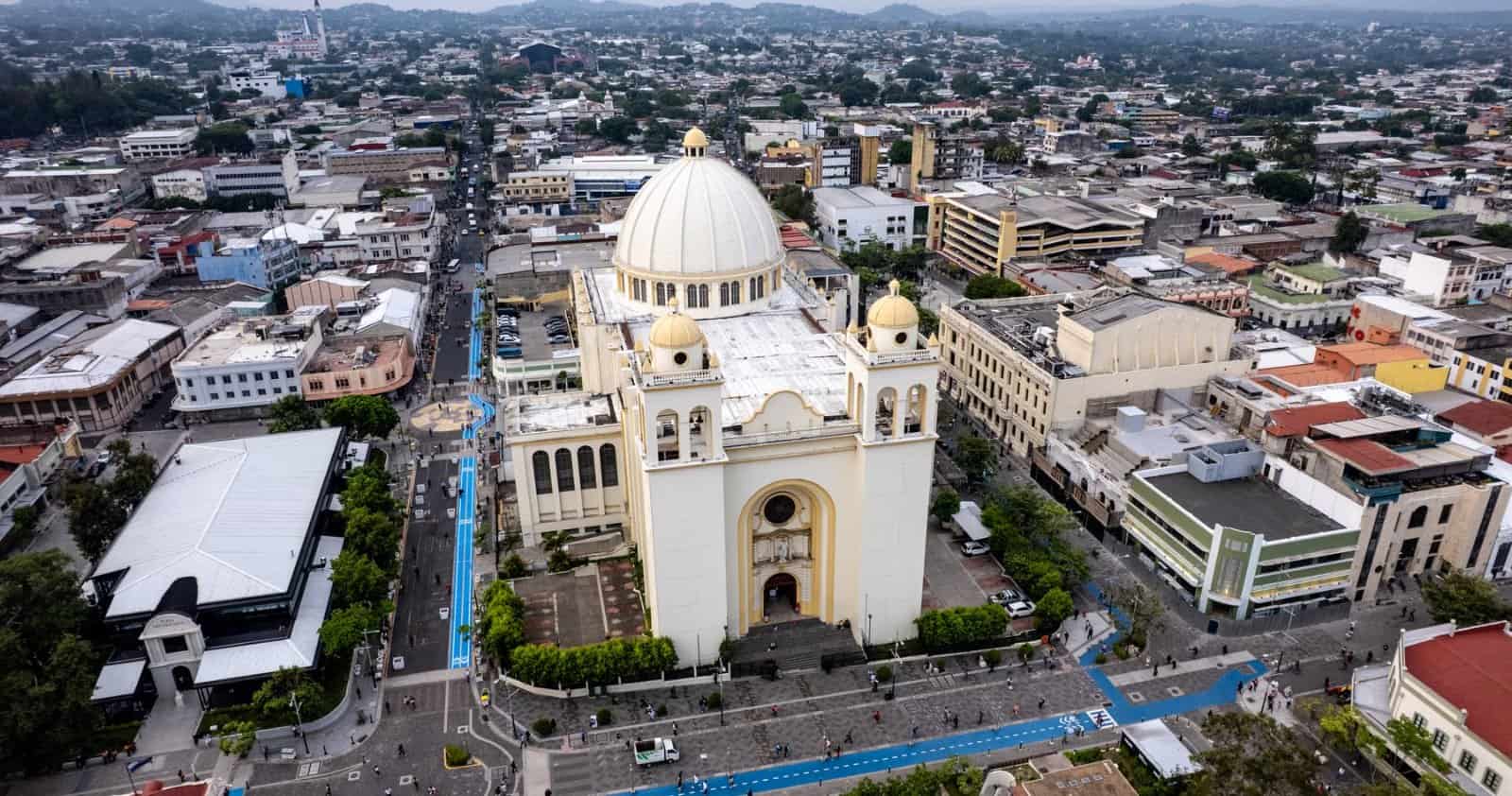
This El Salvador tax guide covers the rules in force from 1 January 2026. El Salvador taxes only Salvadoran-source income, and since a March 2024 reform foreign dividends, interest and capital gains are not taxable at all. Corporate tax is 30% — 25% below $150,000 of gross taxable revenues — personal rates run 10% to 30% above a $6,600 exempt band, and VAT is 13%. There is no wealth tax, no inheritance tax and no annual property tax. The country is fully dollarised.
Introduction
El Salvador is Central America’s smallest country — roughly 21,000 km² on the Pacific coast between Guatemala and Honduras, with 6.3 million people, a tropical climate and world-class surf. San Salvador is within two hours’ flying time of Miami, Panama City and Mexico City. Spanish is the official language, the legal system codified civil law. The country has been fully dollarised since 2001: the US dollar is legal tender, the colón is out of circulation, and a dollar-based investor carries no currency risk. Politics is dominated by President Nayib Bukele, whose gang crackdown cut the homicide rate from among the world’s highest to 1.36 per 100,000 in 2025 — and who has concentrated power to a degree that draws sustained criticism, including an August 2025 constitutional reform permitting indefinite re-election and six-year terms. Living costs are a fraction of Panama’s or Costa Rica’s.
This El Salvador tax guide matters because the country has quietly built one of the most aggressive territorial systems in the Americas. It has always taxed only Salvadoran-source income, but in March 2024 the Assembly added numeral 4 to Article 3 of the Income Tax Law, declaring everything obtained abroad — dividends, interest, capital gains, any movement of capital — a renta no sujeta, outside the scope of the tax entirely, and repealing the provisions that had taxed foreign securities returns and foreign bank interest at 10%. In April 2025 it lifted the personal exempt band from $4,064 to $6,600, with matching withholding tables under Executive Decree No. 10 of 30 April 2025. On 21 April 2026, Legislative Decree 544 removed the 3% withholding on non-domiciled investors’ Salvadoran securities returns. Layered on top: a 15-year tax holiday for technology businesses and a blanket exemption for registered digital assets — residue of a bitcoin experiment itself scaled back on 1 May 2025 to satisfy the IMF.
Direct Taxes
El Salvador is strictly territorial. Residents and non-residents alike are taxed only on income from goods located, activities carried out or capital invested in the country, plus services rendered or used there. There is no worldwide taxation, no CFC regime and no remittance test — foreign income sits outside the base whether or not it is brought in. An individual becomes tax-domiciled by residing in El Salvador for more than 200 days in a calendar year, or by having their main source of income there; a company is domiciled if incorporated or effectively seated there. Personal rates are progressive in four bands, corporate rates effectively flat, and the signature concept is Article 3(4) — the foreign-income carve-out that makes a resident with purely offshore income a 0% taxpayer.
Personal income tax (2026 bands)
| Annual net income | Tax |
|---|---|
| $0.01 – $6,600.00 | Exempt |
| $6,600.01 – $9,142.86 | $212.12 + 10% on the excess over $6,600.00 |
| $9,142.87 – $22,857.14 | $720.00 + 20% on the excess over $9,142.86 |
| $22,857.15 and above | $3,462.86 + 30% on the excess over $22,857.14 |
| Non-domiciled individuals | 30% flat on Salvadoran-source net income |
These bands took effect in May 2025 under a reform to Article 37 of the Income Tax Law, replacing a structure in place since 2011 under which only the first $4,064 was exempt. The upper bands were untouched, so this is a floor-lift, not a rate cut; the Ministry of Finance simultaneously replaced the 2015 withholding tables with ones exempting the first $550 of monthly salary. Salaried taxpayers earning up to $9,100 a year get a built-in $1,600 deduction and file no return; above that they may deduct up to $800 of medical expenses and $800 of school fees. Returns are due by 30 April. Note the 30% top rate bites at just $22,857.15 — a very low ceiling, which is why the territorial rule, not the rate table, decides a foreign investor’s bill.
Corporate income tax
| Item | Rate |
|---|---|
| Standard corporate income tax | 30% |
| Reduced rate — gross taxable revenues of $150,000 or less | 25% |
| Monthly advance payment (pago a cuenta) on gross revenue | 1.75% |
| Dividend distribution — definitive withholding | 5% |
| Dividends and other payments to tax-haven jurisdictions | 25% |
| General withholding on payments to non-residents | 20% |
| Free zones / International Services Law / technology regime — effective rate | 0% |
The 25% reduced rate turns on gross taxable revenues of $150,000 or less — a cliff edge, not a graduated band, so a company crossing it pays 30% on everything. The 1.75% monthly advance is creditable but is a real cash-flow cost for low-margin businesses and, in a loss year, produces a refund claim rather than no tax. El Salvador needs no participation exemption: foreign dividends received by a Salvadoran company already fall outside the base under Article 3(4). It has no foreign tax credit and only one double tax treaty — with Spain. No qualified domestic minimum top-up tax has been enacted, so the exempt regimes below stay genuinely 0% domestically, but groups above Pillar Two’s €750m (~$855m) threshold should expect the difference collected elsewhere.
Social security and health contributions
| Contribution | Employee | Employer | Self-employed |
|---|---|---|---|
| ISSS (health and maternity) | 3% | 7.50% | Voluntary affiliation |
| AFP (pension) | 7.25% | 8.75% | Voluntary affiliation |
| Vocational training levy | — | 1% | — |
ISSS contributions are capped at a $1,000 monthly salary ceiling, so the maximum is $30 a month for the employee and $75 for the employer — trivial on a high salary. AFP pension contributions totalling 16% apply to full monthly salary under the system overhauled in December 2022. The 1% training levy applies on salaries up to $1,000 a month, generally only for employers with ten or more staff. The practical effect: Salvadoran payroll is cheap, and a resident living on foreign investment income has no contribution obligation at all.
Indirect Taxes
Indirect tax is dominated by a single-rate VAT with no reduced bands, supplemented by targeted excises and a transfer tax on real estate. The rules sit in the domestic Ley de IVA, and Central American Common Market membership drives the customs tariff.
Value-added tax (VAT)
| Rate | Applies to (examples) |
|---|---|
| 13% (standard) | Most goods and services, including commercial and industrial property leases |
| 0% (zero) | Exports of goods and services |
| Exempt | Public health services, residential leases, authorised educational services, public transport, insurance premiums, water supplied by public bodies |
There is no reduced rate — one positive VAT rate, held at 13% since 1995, which keeps compliance simple but leaves no relief for food, books or utilities. Exporters are zero-rated and recover input VAT, which is what makes the services and free-zone regimes commercially workable. Residential leases are exempt, so a landlord letting flats stays outside VAT while one letting offices does not.
Excise and other indirect taxes
| Tax | Notes |
|---|---|
| Alcoholic beverages | $0.09 to $0.16 per 1% alcohol by volume per litre, plus 8% ad valorem |
| Tobacco | $0.005 per cigarette, plus 39% ad valorem on the suggested retail price |
| Soft drinks | 10% ad valorem on the suggested retail price, excluding VAT |
| Energy drinks | $0.20 per litre, plus 5% ad valorem |
| Fuel | Road-fund and public-transport levies charged per gallon |
| Real estate transfer tax | 3% on the portion of the price exceeding $28,571.43 |
| Import duties | 0% to 15% under the Central American common external tariff; preferential rates under CAFTA-DR |
| Municipal taxes | Levied on business net assets; annual municipal transit tax of $3.43 for individuals |
The transfer tax threshold is the dollar equivalent of the statutory ₡250,000 figure at the fixed ₡8.75 rate fossilised in the Monetary Integration Law — much Salvadoran tax legislation still carries pre-2001 colón amounts translated that way. Municipal taxes on net assets are the one recurring business levy the free-zone and services regimes exempt, and are worth modelling for an asset-heavy operation.
Other Taxes Worth Knowing
| Tax | El Salvador treatment |
|---|---|
| Capital gains tax | 10% flat on net gains from assets held more than 12 months; taxed at ordinary progressive rates (up to 30%) if the asset is sold within 12 months of acquisition. Capital losses offset capital gains only, carried forward five years |
| Foreign-source income (all types) | None — not subject to tax at all since the March 2024 reform, for residents and non-residents alike |
| Dividends (resident individual, Salvadoran company) | 5% definitive withholding. Foreign dividends: 0% |
| Interest (resident individual) | 10% on Salvadoran bank deposits, but exempt where the individual’s average deposit balance stays below $25,000. Foreign interest: 0% |
| Salvadoran-listed securities | 0% for non-domiciled investors from 21 April 2026 (Legislative Decree 544 repealed the 3% withholding); 10% for domiciled individuals |
| Digital assets registered under the Digital Assets Issuance Law | 0% — nominal value, returns and capital gains exempt from all taxes, levies and contributions |
| Rental income | Ordinary progressive rates up to 30% for residents; 30% flat on net rents for non-residents. 13% VAT on commercial leases; residential leases exempt |
| Wealth / net worth tax | None |
| Inheritance / estate tax | None — no standalone inheritance tax exists |
| Gift tax | None as a separate tax; donations can be taxable income to the recipient, but gifts between spouses and between ascendants and descendants are excluded |
| Immovable property tax (annual) | None — El Salvador levies no annual property tax on real estate |
| Exit tax | None |
Capital gains are where investors most often misread El Salvador. The 10% rate applies only to non-habitual disposals of assets held over a year; flip a property inside twelve months and the gain is ordinary income at up to 30%, and if dealing is your trade it is business income regardless of holding period. The more important line is the second: because foreign income is not subject to tax, a resident whose portfolio, businesses and property sit outside El Salvador pays zero — no minimum tax, no annual fee, no lifetime cap. With no wealth, inheritance or annual property tax either, the burden on a purely offshore investor is among the lowest available short of a zero-tax island.
Disadvantages & Risks
The dominant risk here is not tax, it is governance. El Salvador is effectively a one-party state under a president who now faces no term limit, after the Assembly approved indefinite re-election and six-year terms in August 2025. A state of exception declared in March 2022 has been extended more than fifty consecutive times, suspending constitutional due-process guarantees; tens of thousands have been detained under it, and the Inter-American Commission on Human Rights has documented arbitrary detention and deaths in custody. That machinery transformed security — and showed how fast Salvadoran law can be rewritten when the executive wants it rewritten. The 2024 foreign-income exemption passed in a single session; a future government could repeal it as quickly. Relying on Article 3(4) surviving a decade is a bet on political continuity, not on a treaty or a constitutional guarantee.
The economics matter too. This is a small economy — roughly $38 billion of GDP — with public debt near 90% of GDP, growth slowing to about 3%, and structural dependence on remittances worth roughly a quarter of GDP. El Salvador entered a $1.4 billion IMF Extended Fund Facility in February 2025, and its conditions are what forced the retreat from bitcoin as mandatory legal tender — approved that January, in force from 1 May 2025 — and the closure of the state Chivo wallet. The banking sector is shallow, correspondent relationships limited, and non-resident account opening slow: expect months, not weeks. On transparency the picture beats the reputation — El Salvador is not on the FATF grey or black lists, and appears on neither Annex I nor Annex II of the EU list of non-cooperative jurisdictions as updated in February 2026. But with one double tax treaty and no foreign tax credit, foreign withholding on inbound income is a dead cost, and substance challenges from higher-tax home countries cannot be answered with a treaty tie-breaker. The crypto sector also stays under close scrutiny, and a jurisdiction marketing citizenship for bitcoin should expect its residents’ banking relationships elsewhere to draw extra questions.
Strategy & Ideal Profile
The structures divide cleanly in two. For offshore income, none is needed: become tax-domiciled by spending more than 200 days a year in the country, hold assets and companies outside it, and Article 3(4) takes foreign dividends, interest and capital gains out of the base. For Salvadoran-source operating income, the answer is a regime rather than a plain company. An S.A. de C.V. in a free zone or qualifying under the International Services Law is exempt from corporate income tax, municipal taxes and import duties on services rendered to non-residents; 2026 reforms added a further ten years of exemption on proof of expanded investment and set park-user investment thresholds from $150,000 for business process services to $1,000,000 for medical services. The Law for the Promotion of Innovation and Technology Manufacturing, in force since June 2023, goes further: total exemption from income tax, municipal taxes on net assets and import duties for 15 years, covering software, cloud computing, AI, big data, semiconductors, robotics and nanotechnology. Digital-asset issuers and providers registered with the CNAD are exempt on the value, returns and disposal gains of registered assets — but not on fiat exchange, brokerage or third-party custody.
Who it suits: company owners in software, AI, BPO and technology manufacturing, for whom the 15-year exemption is close to unbeatable; investors and traders holding offshore portfolios, since foreign gains and dividends are untaxed and no wealth, inheritance or property tax erodes the base; dividend earners drawing from non-Salvadoran holding companies, at 0% rather than the 5% on domestic distributions; crypto holders, who get a statutory exemption for registered digital assets plus the $1,000,000 bitcoin or USDT Freedom Visa route to citizenship, capped at 1,000 places a year; and retirees, whose foreign pensions sit outside the base. The residency rules are generous at both ends: 200 days makes you tax-domiciled if you want to be, while a 2026 reform to the Migration Law cut the presence requirement for maintaining temporary residence from nine continuous months to 90 days a year.
Who it does not suit: anyone earning genuinely Salvadoran-source income outside an incentive regime, since 30% corporate tax, a 1.75% monthly levy on gross revenue and a 30% top personal rate from $22,857 add up to an ordinary mid-to-high-tax country; anyone needing a treaty network; anyone taxed on citizenship, which means US citizens gain nothing on their US filing obligations by moving here; and anyone needing deep, fast, internationally-connected banking. The limit of the headline benefit bears stating plainly: the foreign-income exemption is an ordinary statutory provision passed in 2024 by simple majority, with no sunset clause and no grandfathering — which cuts both ways.
FAQ
Is El Salvador a tax haven?
Not by the formal definitions. El Salvador is on neither the FATF grey or black list nor Annex I or Annex II of the EU list of non-cooperative jurisdictions as at February 2026, and it levies real taxes — 30% corporate, up to 30% personal, 13% VAT — on domestic activity. What it offers is territoriality taken to its logical end: since March 2024, foreign-source income of any kind is outside the tax base. That gives tax-haven outcomes to a resident with offshore income while leaving domestic business taxed at ordinary rates.
What is the corporate tax rate in El Salvador in 2026?
30% on taxable income, reduced to 25% for companies whose gross taxable revenues are $150,000 or less. Companies also pay a monthly advance of 1.75% of gross revenue, creditable against the annual liability. Businesses under the free-zone regime, the International Services Law or the technology promotion law are exempt from corporate income tax altogether — the technology regime for 15 years.
How does the foreign-income exemption work?
Article 3, numeral 4 of the Income Tax Law, added in March 2024, makes all amounts obtained abroad in any concept — dividends, capital gains, returns on securities, interest on foreign deposits, any movement of capital — rentas no sujetas, falling outside the scope of the tax rather than being exempted from it. It applies to domiciled and non-domiciled persons alike, natural and legal, and repealed the provisions that had taxed foreign securities returns and foreign bank interest at 10%.
What is the 200-day residency rule?
An individual becomes tax-domiciled by residing in El Salvador for more than 200 days in a calendar year, or by having their main source of income there. Immigration residence has a separate test: a 2026 reform to the Special Migration and Foreigners Law cut the presence requirement for maintaining temporary residence from nine continuous months to 90 days a year. The two thresholds are independent, so holding residence without being tax-domiciled is possible.
Does El Salvador tax capital gains?
Yes, on Salvadoran-source gains only. Net gains on assets held more than 12 months are taxed at a flat 10%; assets sold within 12 months are taxed as ordinary income at up to 30%. Losses offset capital gains only and carry forward five years. Foreign capital gains are not subject to tax, gains on digital assets registered under the Digital Assets Issuance Law are exempt, and since 21 April 2026 non-domiciled investors pay nothing on Salvadoran securities market returns.
Is there inheritance or wealth tax in El Salvador?
No. There is no inheritance or estate tax, no standalone gift tax, no net wealth tax and no annual property tax. Donations may be taxable income to the recipient, but transfers between spouses and between ascendants and descendants are excluded. The main transaction cost on property is the 3% transfer tax above $28,571.43.
How are dividends taxed for a foreign investor?
Dividends from a Salvadoran company carry a 5% definitive withholding tax, rising to 25% where the recipient is domiciled in a tax haven or preferential regime. Dividends from non-Salvadoran companies received by a Salvadoran resident are not subject to tax at all. With only one treaty — Spain, which cuts the dividend rate to 12%, or nil for holdings of 50% or more — there is no treaty relief for investors from most countries.
Sources
All figures should be checked against the primary government sources below.
- Ministerio de Hacienda / Dirección General de Impuestos Internos — income tax rates and bands, VAT, withholding tables, advance payments, filing deadlines — mh.gob.sv
- Portal de Transparencia Fiscal — consolidated texts of the Ley de Impuesto sobre la Renta, Ley de IVA and Código Tributario — transparencia.mh.gob.sv
- Asamblea Legislativa de la República de El Salvador — reform decrees, including the 2024 foreign-income reform, the 2025 Article 37 reform and Legislative Decree 544 of 2026 — asamblea.gob.sv
- Imprenta Nacional / Diario Oficial — official publication and effective dates of all decrees cited — imprentanacional.gob.sv
- Instituto Salvadoreño del Seguro Social (ISSS) — health and maternity contribution rates and the salary ceiling — isss.gob.sv
- Superintendencia del Sistema Financiero — AFP pension contribution rates and maximum contributory salary — ssf.gob.sv
- Comisión Nacional de Activos Digitales (CNAD) — Digital Assets Issuance Law, registration of issuers and service providers, and the associated exemptions — cnad.gob.sv
- Dirección General de Migración y Extranjería — residence categories, physical-presence requirements and investor residence — migracion.gob.sv
- Invest in El Salvador — free zones, International Services Law and technology promotion law incentives — investinelsalvador.gob.sv
- Banco Central de Reserva de El Salvador — monetary integration, legal tender status of the US dollar and the statutory colón conversion rate — bcr.gob.sv
The Salvadoran colón was replaced by the US dollar as legal tender under the Monetary Integration Law with effect from 1 January 2001, at a fixed statutory rate of ₡8.75 = US$1. All figures in this guide are already stated in US dollars, so no currency conversion applies; the only colón figure that survives in the underlying legislation is the ₡250,000 real estate transfer tax threshold, shown above at its statutory dollar equivalent of $28,571.43.
Last verified: 29 August 2026.
This is general information, not personal tax or legal advice. Tax outcomes depend on your specific facts; consult a qualified El Salvador tax adviser before acting.
Related guides: Andorra · Argentina · Australia · Bahamas · Botswana · Brunei · Bulgaria · Ceuta and Melilla · Chile · China · Costa Rica · Cyprus · Denmark · Dominican Republic · Estonia · Florida · Georgia · Gibraltar · Greece · Hawaii · Hong Kong · Iceland · Indonesia · Isle of Man · Italy · Jersey · Kuwait · Latvia · Macau · Malta · Mauritius · Monaco · Montenegro · Morocco · New Zealand · Panama · Paraguay · Philippines · Portugal · Puerto Rico · Romania · Sark · Seychelles · Singapore · South Korea · Taiwan · Thailand · Ticino · UAE · Uruguay · Zug