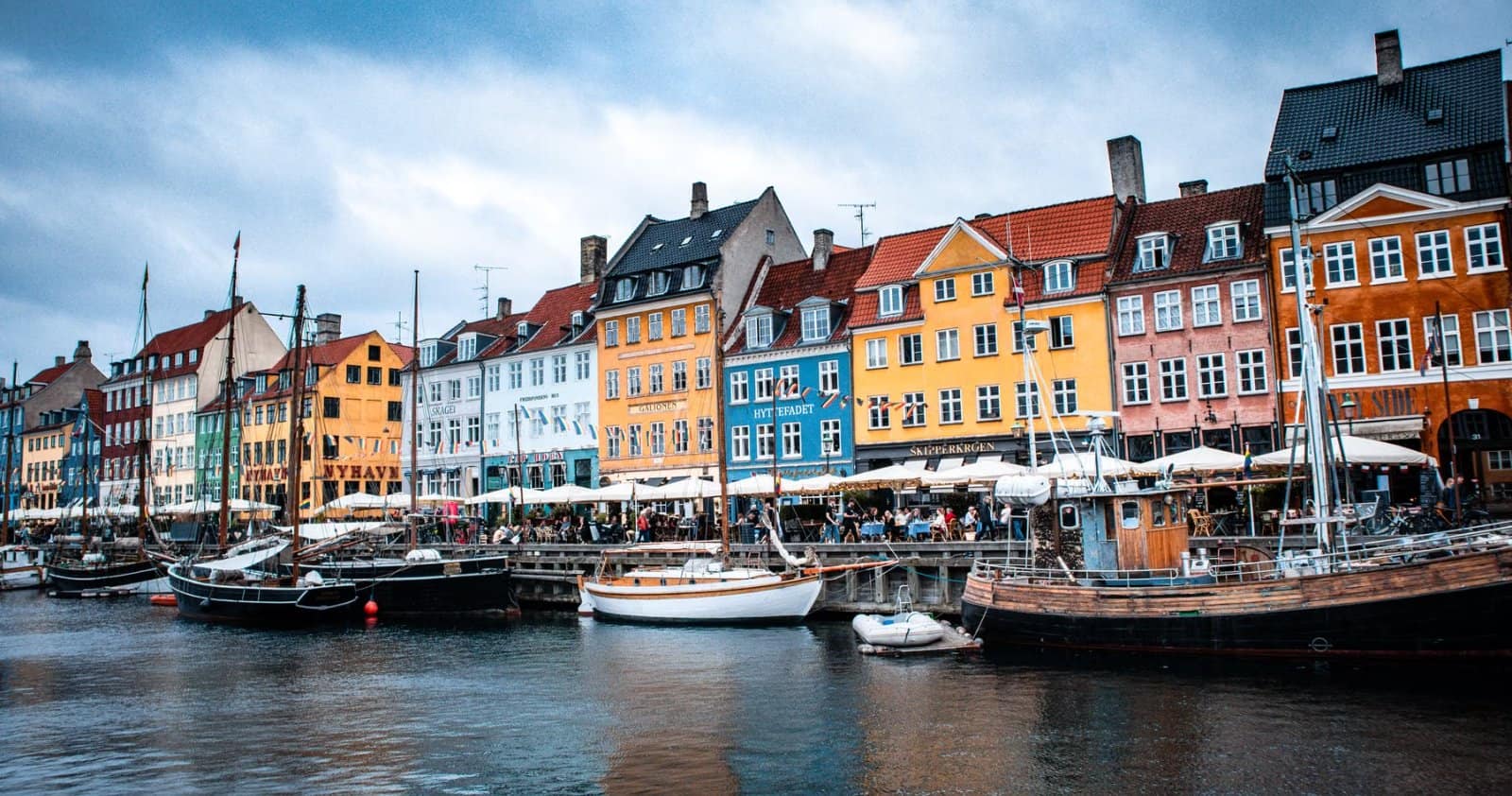
This Denmark tax guide covers the rules in force from 1 January 2026. Denmark taxes residents on worldwide income at marginal rates reaching 60.5%, but pairs that with a flat 22% corporate rate, a full participation exemption, no wealth tax and a tax-free main home. Two changes landed on 1 January 2026: the single top-tax bracket split into three — mellemskat, topskat and toptopskat — and the salary bar for the 27% expat scheme fell by roughly 16%.
Introduction
Denmark is a Nordic constitutional monarchy of about six million people, an EU member since 1973 but outside the euro — the krone is pegged to it at a central rate of DKK 7.46038 under ERM II, giving hard-currency stability without eurozone membership. The legal system is civil law, politics are stable and coalition-based, and the country ranks near the top of global rule-of-law, low-corruption and digital-government indices. Danish is official, but English is near-universal and is the operating language of most large employers. The climate is temperate maritime and the cost of living among the highest in the EU.
This Denmark tax guide matters because Denmark is emphatically not a low-tax jurisdiction, yet it keeps appearing on relocation shortlists. The burden is concentrated in one place: ordinary employment income. Corporate profits are taxed at a flat 22%, dividends and gains on qualifying shareholdings are exempt in corporate hands, foreign permanent establishments and foreign real property sit outside the Danish corporate base by default, R&D spending attracts a 114% deduction in 2026, and inbound specialists can pay a flat 32.84% on gross salary for seven years. From 1 January 2026 that scheme became far easier to reach: the minimum monthly salary fell from DKK 78,000 (~$12,100) to DKK 65,400 (~$10,200).
Direct Taxes
Danish residents are taxed on worldwide income. Full liability is triggered by taking up residence — acquiring or renting a home and staying for more than a short holiday — or by a continuous stay of at least six months, in which case liability runs from day one. Companies are resident if registered in Denmark or effectively managed there. Personal income is layered: 8% labour market contribution (AM-bidrag) off the top, then municipal tax, then a progressive stack of state brackets. The signature regime for mobile professionals is the forskerskatteordning, the researcher and key-employee scheme.
Personal income tax (2026 bands)
| Personal income after 8% AM-bidrag (DKK / USD) | State bracket | Typical combined marginal rate |
|---|---|---|
| Up to 54,100 (~$8,400) — personal allowance | — | 0% |
| 54,100–641,200 (~$8,400–99,600) | 12.01% (bundskat) | ~42.1% |
| 641,200–777,900 (~$99,600–120,900) | +7.5% (mellemskat) | ~49.0% |
| 777,900–2,592,700 (~$120,900–402,900) | +7.5% (topskat) | ~55.9% |
| Above 2,592,700 (~$402,900) | +5% (toptopskat) | ~60.5% |
Marginal rates include the 8% AM-bidrag and the 2026 average municipal rate of 25.049%; municipal rates are set locally and vary a few points either side. These bands took effect on 1 January 2026 under a reform the Folketing adopted in May 2024. They replaced a single 15% top tax starting at DKK 611,800 (~$95,100) in 2025, so the higher-rate entry point rose sharply while a new 5% surcharge appeared above DKK 2,592,700 (~$402,900). Statutory ceilings cap the combined state-plus-municipal rate at 44.57%, 52.07% and 57.07% at the three levels; capital income is capped separately at 42%. Thresholds are measured after AM-bidrag, so gross-salary equivalents run about 8.7% higher — roughly DKK 845,500 (~$131,400) of gross pay before topskat bites. An employment allowance of 12.75%, capped at DKK 63,471 (~$9,900), applies to earnings; church tax at about 0.87% is voluntary.
Corporate income tax
| Item | Rate |
|---|---|
| Standard corporate income tax | 22% |
| Financial sector companies (from 2024) | 26% |
| Financial sector companies (2023) | 25.2% |
| Hydrocarbon activities (ring-fenced + special hydrocarbon tax) | 25% + 52% (≈64% combined) |
| Dividends and gains on subsidiary/group shares (≥10%) | 0% — participation exemption |
| Dividends on unlisted portfolio shares (<10%), from 1 Jan 2025 | 0% (previously ~15.4%) |
| Enhanced R&D deduction (2026) | 114% up to DKK 1bn (~$155m); 110% above |
The 22% rate has been stable for a decade and applies to the ApS and A/S alike. Denmark implemented OECD Pillar Two through its Minimum Taxation Act for fiscal years beginning on or after 31 December 2023, but it bites only on groups with consolidated revenue of at least €750m (~$871m) in two of the last four years — irrelevant to almost every owner-managed business. Outbound dividend withholding is 27%, falling to 0% for subsidiary and group shares held by an EU or treaty-resident beneficial owner; interest and royalties carry 22% with wide exemptions, and a punitive 44% applies to recipients on Denmark’s national list of non-cooperative territories. Carried-forward losses offset income in full up to DKK 21,830,700 (~$3.39m) and 60% of the excess, with no time limit. The R&D deduction rises to 116% in 2027 and 120% from 2028, and loss-making R&D companies can claim a cash refund worth 22% of qualifying losses, capped at DKK 5.5m (~$855,000).
Social security and health contributions
| Contribution | Employee | Employer | Self-employed |
|---|---|---|---|
| Labour market contribution (AM-bidrag) | 8% of gross income | — | 8% of business profit |
| ATP supplementary pension (full-time) | DKK 1,188/yr (~$185) | DKK 2,376/yr (~$370) | Voluntary |
| Other statutory levies (industrial injuries, maternity fund, AUB) | — | ~DKK 13,000/yr (~$2,000) | — |
| Indicative total employer cost per full-time employee | — | ~DKK 16,000/yr (~$2,500) | — |
Denmark funds its welfare state through general taxation rather than payroll charges, so the employer side is remarkably light — around DKK 16,000 (~$2,500) a year per full-time employee, against 25–35% of salary in France or Spain. ATP rose to DKK 297 (~$46) a month in 2026, split one-third employee, two-thirds employer. There is no separate health levy; healthcare is tax-funded and free at the point of use. AM-bidrag is legally a tax rather than a contribution, and is charged on gross income before any allowance.
Indirect Taxes
Denmark applies the EU VAT Directive but made an unusual choice within it — a single standard rate with no reduced rate at all. VAT is the main indirect tax, alongside deep excise duties and one of the world’s highest vehicle taxes.
Value-added tax (VAT / moms)
| Rate | Applies to (examples) |
|---|---|
| 25% (standard) | Nearly all goods and services — Denmark operates no reduced rate |
| 0% (zero) | Exports, intra-EU supplies to VAT-registered customers, international transport, ships and aircraft in international traffic, newspapers published more than once a month |
| Exempt (no input recovery) | Financial services, insurance, healthcare, education, residential letting |
Registration is compulsory once taxable turnover exceeds DKK 50,000 (~$7,800) in any 12-month period — a very low bar that catches most side businesses in year one. Non-established businesses must register from the first taxable supply. Firms in the exempt sectors instead pay a payroll tax (lønsumsafgift) of up to 15.3% for banks and other financial institutions.
Excise and other indirect taxes
| Tax | Notes |
|---|---|
| Excise duties | Alcohol, tobacco, chocolate and confectionery, coffee, packaging, energy and oil products |
| Vehicle registration tax | 25% up to DKK 76,400 (~$11,900); 85% from DKK 76,400 to DKK 237,400 (~$36,900); 150% above, less a general deduction of DKK 25,500 (~$4,000) |
| Electric vehicle relief | Extra deduction of DKK 161,300 (~$25,100), and only 40% of the computed tax payable for cars registered before 2027, phasing in to 2036 |
| Registration duty (tinglysningsafgift) | DKK 1,850 (~$290) plus 1.25% on mortgage deeds; DKK 1,850 plus 0.6% on transfers of title |
| Share transfers | None — no stamp or transfer duty |
Registration tax deserves attention from anyone relocating: a car costing €35,000 (~$40,700) elsewhere in the EU lands far higher in Denmark once the 85% and 150% bands apply. That is why the Danish fleet skews old and small, and why electric vehicles have taken share so fast.
Other Taxes Worth Knowing
| Tax | Danish treatment |
|---|---|
| Capital gains tax (shares) | Share income scale: 27% up to DKK 79,400 (~$12,300); 42% above (DKK 158,800 / ~$24,700 for married couples) |
| Dividends (resident individual) | Same 27% / 42% share income scale |
| Interest (resident individual) | Capital income — taxed at up to 42% |
| Rental income | Capital income (up to 42%), or personal income if run as a business |
| Share savings account (aktiesparekonto) | 17% on annual mark-to-market gains; deposits capped at DKK 174,200 (~$27,100) |
| Wealth / net worth tax | None — abolished in 1997 |
| Inheritance / estate duty (boafgift) | Spouse exempt; 15% for children and close relatives above DKK 392,300 (~$61,000); a 25% supplement for distant heirs (≈36.25% combined) |
| Gift tax (gaveafgift) | 15% above DKK 80,600 (~$12,500) per donor, per child, per year; DKK 28,200 (~$4,400) for children-in-law; 10% for qualifying business succession |
| Immovable property tax (annual) | Property value tax 0.51% up to DKK 9,007,000 (~$1.4m) and 1.4% above, plus municipal land tax (grundskyld) up to 30‰ — both on 80% of assessed value |
| Sale of main home | Exempt under the parcelhusregel where the owner lived there and the plot is under 1,400 m² |
| Exit tax on shares | Deemed disposal on emigration where holdings are worth DKK 100,000 (~$15,500) or more and the person was taxable in Denmark for 7 of the last 10 years |
The investor picture is less punishing than the income table implies. A couple pays 27% on the first DKK 158,800 (~$24,700) of annual share income before the 42% band starts, a share savings account taxes up to DKK 174,200 (~$27,100) of capital at a flat 17%, and gains on a main home fall outside the net entirely. The exit tax is real, but payment can be deferred indefinitely and interest-free if claimed by 1 July of the year after departure.
Disadvantages & Risks
Denmark is a high-tax country with an aggressively broad residence test. Full liability arises from a home plus more than holiday presence — there is no day-count safe harbour of the kind Cyprus or Malta offer, and Danish practice treats a home plus three consecutive months, or 180 days in any twelve, as residence. Once resident, worldwide income is caught, foreign structures face some of the strictest CFC rules in the EU — applied without a genuine-activity carve-out, even inside the EU — and departure triggers the exit tax on shares. Denmark produced the CJEU’s leading beneficial-ownership judgments in 2019 and still litigates hard against holding companies it treats as conduits: substance requirements are enforced, not nominal. There is also no double tax treaty with Spain, terminated in 2008 and never replaced.
On reputation the picture is broadly reassuring: Denmark is an EU and OECD member, appears on no EU or OECD list of non-cooperative jurisdictions, and is a FATF member in good standing. But the banking sector carries the residue of the Danske Bank affair — roughly €200bn (~$232bn) of suspicious flows through its Estonian branch and a $2bn US resolution in 2022 — so account opening for non-residents and complex structures is slower than the country’s digital reputation suggests, and the Tax Agency’s own DKK 12.7bn (~$2bn) dividend-refund fraud has left withholding reclaims heavily documented. Denmark is a small, open economy with unusual concentration in pharmaceuticals, sits close to the Baltic security frontier, and faces recurring friction over Greenland’s status. The 2026 reform also cuts both ways: it raised the point at which higher rates start, but pushed the top marginal rate to 60.5%.
Strategy & Ideal Profile
The structure that works is a Danish holding company (ApS) over one or more operating companies. Dividends and gains on subsidiary shares of 10% or more are exempt in the holding company, and since 1 January 2025 so are dividends on unlisted portfolio shares below 10% — making an ApS a clean vehicle for founders holding minority stakes in other people’s businesses. Profits are taxed once at 22%, accumulate tax-free, and are taxed again only on extraction, for an all-in effective rate of roughly 43% to 54.8% on distributed profit. Minimum share capital is DKK 20,000 (~$3,100), incorporation is a same-week digital process, and there is no minimum-investment threshold to buy into any regime. Add the 114% R&D deduction, 108% depreciation on new operating assets acquired through 31 December 2026, and the DKK 5.5m (~$855,000) R&D cash credit, and Denmark is a credible base for a genuinely operating technology or life-sciences business.
Denmark suits company owners wanting a low, stable corporate rate with a real participation exemption, and highly-paid specialists and executives above all. The forskerskatteordning taxes gross salary at 27% plus 8% AM-bidrag — 32.84% all-in — for up to 84 months, once in a lifetime, provided the employee was not taxable in Denmark for the previous 10 years and earns at least DKK 65,400 (~$10,200) a month after ATP. That bar is roughly 16% lower than in 2025, bringing a wide band of senior engineers, product leads and mid-level executives into range for the first time; researchers with a PhD-level qualification face no salary requirement at all. Residence is established simply by taking a home and moving in — no investment route, no minimum stay to maintain. Entrepreneurs also get a 10% rate on business succession gifts to children.
Denmark does not suit passive investors, retirees or dividend-only earners: there is no non-dom regime, no remittance basis, no flat tax on foreign income and no reduced rate for pensions, so a retiree living on foreign dividends pays the full 27%/42% scale. Nor does it suit anyone wanting a low-visibility structure, given automatic third-party reporting and CFC attribution. The headline benefit also has a hard sunset — at month 85 the taxpayer moves onto the ordinary scale at up to 60.5%, which is why most users plan their exit or equity event before the seven years run out.
FAQ
Is Denmark a tax haven?
No — close to the opposite. Denmark has one of the highest tax-to-GDP ratios in the OECD, taxes residents on worldwide income at up to 60.5%, operates strict CFC rules and an exit tax on shares, and appears on no EU or OECD list of non-cooperative jurisdictions. The appeal is a competitive 22% corporate rate and a targeted expat regime, not secrecy.
What is the corporate tax rate in Denmark in 2026?
The standard rate is 22%, unchanged. Financial sector companies pay 26% (up from 25.2% in 2023, applied via a factor model on taxable income), and oil and gas activity on the Danish continental shelf faces a ring-fenced 25% plus a 52% special hydrocarbon tax, roughly 64% combined.
How does the Danish expat tax scheme work?
The forskerskatteordning taxes gross employment income at a flat 27% plus the 8% labour market contribution — an effective 32.84% — for up to 84 months. It requires a minimum monthly salary of DKK 65,400 (~$10,200) in 2026, down from DKK 78,000 (~$12,100) in 2025, no Danish tax liability in the previous 10 years, and no controlling relationship with the employer. No deductions are available against scheme income.
What are the new mellemskat, topskat and toptopskat brackets?
From 1 January 2026 the old single 15% top tax was replaced by three brackets, all measured on personal income after the 8% AM-bidrag: mellemskat at 7.5% above DKK 641,200 (~$99,600), topskat at a further 7.5% above DKK 777,900 (~$120,900), and toptopskat at a further 5% above DKK 2,592,700 (~$402,900). Ceilings cap the state-plus-municipal rate at 44.57%, 52.07% and 57.07%.
Does Denmark tax capital gains?
Yes. Gains on shares form part of share income, taxed at 27% up to DKK 79,400 (~$12,300) a year and 42% above — doubled to DKK 158,800 (~$24,700) for married couples. Gains on a main residence are exempt where the owner lived there and the plot is under 1,400 m². Corporate holders are exempt on subsidiary, group and unlisted portfolio shares.
Is there inheritance or wealth tax in Denmark?
There is no wealth or net worth tax — abolished in 1997. Inheritance carries estate duty (boafgift) of 15% above DKK 392,300 (~$61,000), with transfers to a surviving spouse fully exempt and a 25% supplement for distant heirs taking the combined rate to about 36.25%. Business succession qualifies for a reduced 10% rate.
How are dividends taxed for a non-resident investor?
Denmark withholds 27%. That falls to 0% where the recipient is the beneficial owner of subsidiary or group shares and is resident in the EU or a treaty state, and to the treaty rate — commonly 15% — otherwise. Recipients on Denmark’s national non-cooperative list face 44%. Reclaims are possible but slow, following the DKK 12.7bn (~$2bn) refund fraud of 2012–2015.
Sources
All figures should be checked against the primary government sources below. Only official government bodies are listed here.
- Skattestyrelsen (Danish Tax Agency) — income tax rates, allowances, the expat scheme, exit tax on shares, VAT registration — skat.dk
- Skatteministeriet / Skatte- og Vækstministeriet (Ministry of Taxation) — statutory rates and thresholds, municipal and church tax averages, aktiesparekonto and property tax — svmn.dk
- Motorstyrelsen (Danish Motor Vehicle Agency) — vehicle registration tax bands and EV deductions — motorst.dk
- Beskæftigelses- og Ligestillingsministeriet (Ministry of Employment) — 2026 ATP contribution rates — bm.dk
- Erhvervsstyrelsen (Danish Business Authority) — ApS minimum capital and employer ATP obligations — erhvervsstyrelsen.dk
- Retsinformation (official Danish law portal) — the 2024 personal tax reform, the Iværksætterpakke and the Minimum Taxation Act — retsinformation.dk
- Danmarks Nationalbank — exchange rate used for USD conversions and the ERM II central rate — nationalbanken.dk
USD figures are indicative conversions at ~1 DKK = 0.155 USD (1 USD = 6.4353 DKK, Danmarks Nationalbank reference rate, 3 September 2026) and rounded. The krone is not pegged to the US dollar; it is pegged to the euro at a central rate of DKK 7.46038 under ERM II.
Last verified: 5 September 2026.
This is general information, not personal tax or legal advice. Tax outcomes depend on your specific facts; consult a qualified Danish tax adviser before acting.
Related guides: Andorra · Argentina · Australia · Bahamas · Botswana · Brunei · Bulgaria · Ceuta and Melilla · Chile · China · Costa Rica · Cyprus · Dominican Republic · El Salvador · Estonia · Florida · Georgia · Gibraltar · Greece · Hawaii · Hong Kong · Iceland · Indonesia · Isle of Man · Italy · Jersey · Kuwait · Latvia · Macau · Malta · Mauritius · Monaco · Montenegro · Morocco · New Zealand · Panama · Paraguay · Philippines · Portugal · Puerto Rico · Romania · Sark · Seychelles · Singapore · South Korea · Taiwan · Thailand · Ticino · UAE · Uruguay · Zug